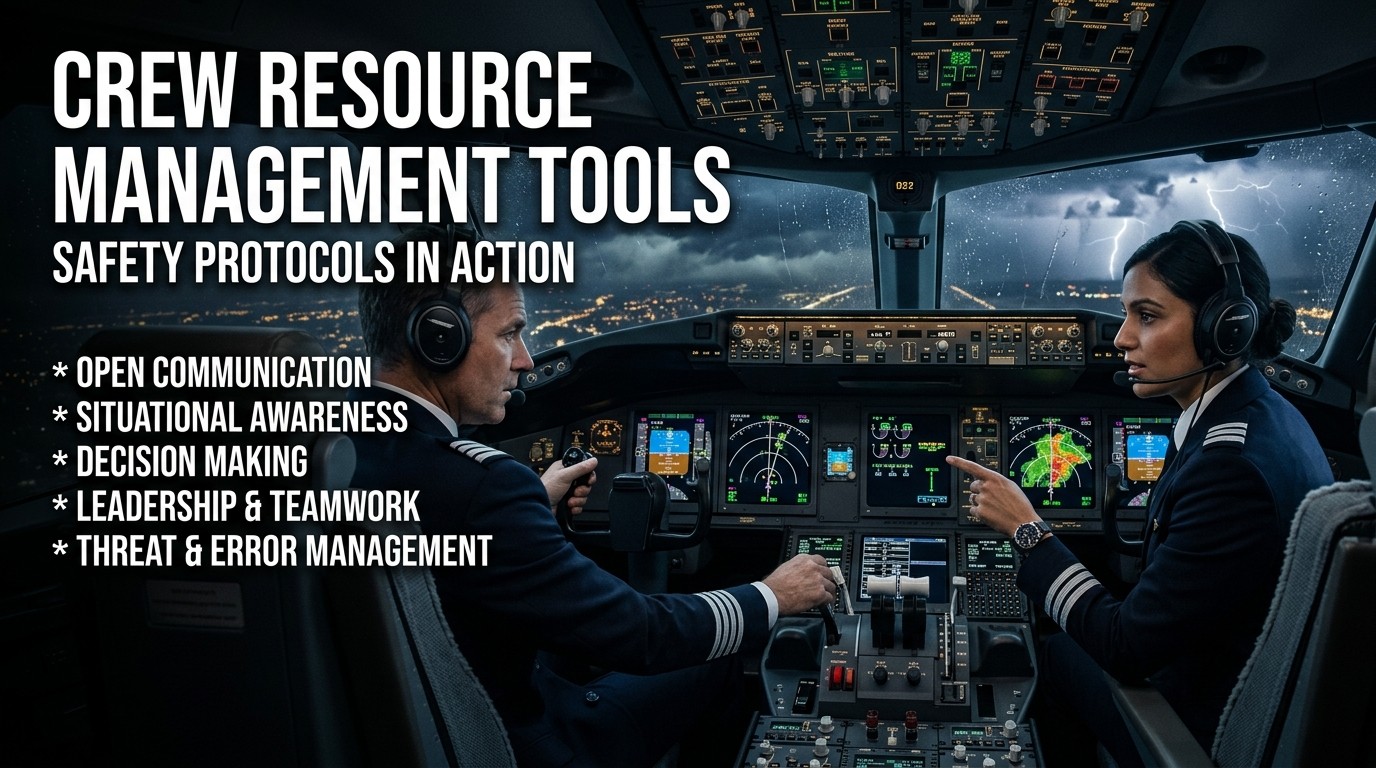
Crew Resource Management Tools help flight crews coordinate, challenge, and verify actions so safety stays disciplined, communication stays clear, and workload stays manageable consistently.
Crew Resource Management Tools are most valuable when they turn good intentions into repeatable habits. In aviation, that matters because crews face changing weather, shifting workload, automation, and time pressure at the same time. FAA guidance treats CRM training as something that should be developed, implemented, reinforced, and assessed, and ICAO guidance says CRM training is meant to become part of normal training and operations. In other words, Crew Resource Management Tools are not an extra layer added after the real work is done; they are part of how safe work is done every day.
Good crews use Crew Resource Management Tools to slow risk before it grows. A cockpit can be highly experienced and still miss a cue if communication is vague, if monitoring is weak, or if a task gets buried under distraction. FAA guidance on SOPs and pilot monitoring says SOPs are fundamental to safe operations and that monitoring must be defined, trained, and integrated into those SOPs. That is why Crew Resource Management Tools matter so much: they create a common way to notice, confirm, and correct problems before they become serious.
Why the safety protocol matters
The best safety culture does not assume people will never make mistakes. It assumes humans will make predictable mistakes and then builds barriers around them. Crew Resource Management Tools do that by making communication structured, making monitoring visible, and making challenge acceptable. FAA CRM guidance describes CRM as the effective use of human resources, hardware, and information to achieve safe and efficient operation, while the ICAO material frames CRM training around situation awareness, communication, teamwork, task allocation, and decision-making and error management. That combination is what gives the protocol its power.
From the outside, Crew Resource Management Tools can look simple: brief, talk, monitor, confirm, and act. In practice, the value lies in repetition. If a crew brief is routine, the crew’s mental model is shared before the flight starts. If a callout is standard, the same words mean the same thing in high workload and low workload alike. Crew Resource Management Tools reduce the mental friction that often hides in small misunderstandings, which is exactly why disciplined teams rely on them as a protocol rather than a personality trait.
Briefings and shared mental models
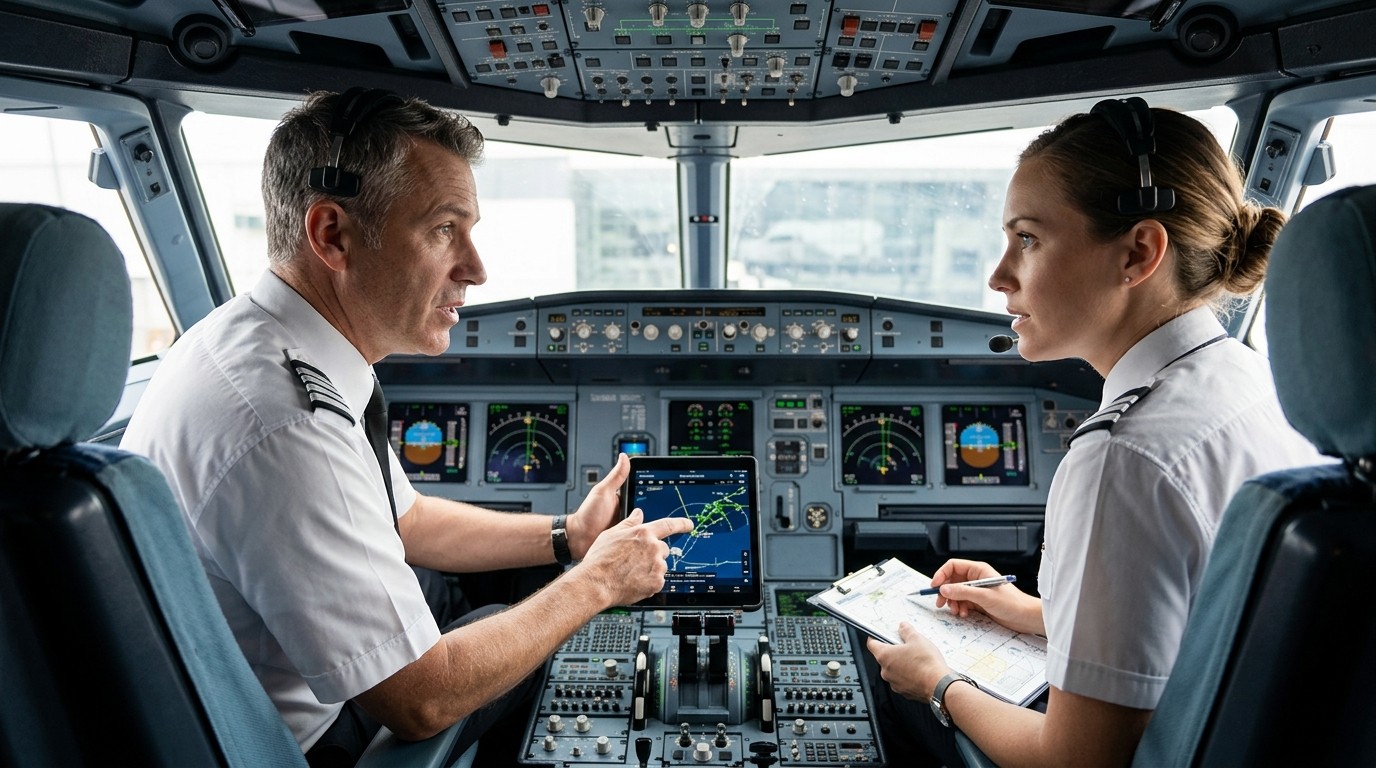
A strong briefing is one of the simplest Crew Resource Management Tools available to a crew. The goal is to leave the briefing with the same picture of the flight: threats, roles, expected changes, runway considerations, weather, automation mode awareness, and the points where extra attention will be needed. FAA SOP guidance says clear, comprehensive SOPs should be readily available, and ICAO CRM guidance emphasizes that training should focus on situation awareness and team coordination. A good briefing makes those ideas concrete.
When crews brief well, they reduce the need to improvise later. That matters because improvisation under pressure often increases confusion. Crew Resource Management Tools are designed to lower that risk by making the starting assumptions visible. A pilot can then speak up earlier if the flight does not match the plan, and the other crewmember can respond without guessing what was meant. In that sense, the briefing is not just a preflight ritual; it is the first safety barrier in the chain.
Shared mental models also help with the softer side of flight mastery. Technical flying skill is important, but the best crews also know how to coordinate under changing conditions. Crew Resource Management Tools make the teamwork side visible so the flight is not carried by memory alone. If the plan changes, the crew can update the model together rather than letting each person privately assume a different story. That alignment is one of the quietest but strongest protections in the cockpit.
Monitoring, cross-checking, and SOP discipline
FAA AC 120-71B says effective monitoring means following SOPs consistently, clearly communicating deviations, managing distractions, and remaining vigilant. That description is almost a field guide for Crew Resource Management Tools. A monitoring role should not be vague. It should be trained, expected, and protected from task overload. When the pilot monitoring role is understood well, the crew is more likely to catch mode changes, altitude deviations, and other early signs of drift.
Good Crew Resource Management Tools do not treat SOPs as paperwork. FAA AC 120-71A says SOPs should be clear, comprehensive, and readily available in manuals used by flight deck crewmembers. That matters because a standard procedure only helps when people can use it quickly in real conditions. The point of SOP discipline is not rigidity for its own sake. It is to make the safe path easier to follow than the risky one.
Cross-checking is more than an attitude; it is a habit that protects against tunnel vision. Crew Resource Management Tools work because one person is never expected to notice everything alone. A callout, a confirmation, or a question can catch a missed switch setting or a mode mismatch before it becomes an operational issue. That redundancy may look small in calm weather, but it becomes extremely valuable when the workload rises and the margin for distraction shrinks.
Communication, challenge, and workload
Communication is the heartbeat of Crew Resource Management Tools. ICAO CRM guidance explicitly includes communication skills, teamwork, task allocation, and decision-making and error management in its training framework. If the crew can speak clearly, listen actively, and confirm understanding, it becomes easier to correct errors early. The goal is not more talk; it is better talk. Short, clear, timely communication often does more for safety than long discussion after the fact.
Workload management is another place where Crew Resource Management Tools matter. The crew should know who is flying, who is monitoring, who is handling radios, and who is watching the broader picture. When one person is task saturated, the other should recognize it and redistribute work before performance drops. The safety value here is psychological as much as procedural: people think more clearly when the team makes overload visible instead of hiding it.
Challenge-response communication is especially important when something does not look right. Crew Resource Management Tools should create a culture where it is normal to question, verify, and pause if a command or trend feels off. That does not weaken authority. It strengthens it by giving the crew a reliable way to surface risk. The calmest crews are often the ones that have already rehearsed respectful challenge before they need it.
In practice, Crew Resource Management Tools lower emotional friction as well as operational risk. People are less likely to freeze when they already know how to speak up, how to back each other up, and how to return to the plan. That kind of fluency is part of sound cockpit judgment because decisions are rarely made in isolation. They are made through small exchanges of information that either sharpen the plan or blur it.
Leadership, command, and crew behavior
Leadership is a major part of Crew Resource Management Tools. FAA guidance on leadership and command training says PIC training should help manage the crew, communications, and workload in a way that promotes professionalism and adherence to SOPs. The same document notes that leadership training is tied closely to CRM modules. That matters because the tone set by the leader shapes whether the crew speaks early or stays silent.
Good leadership makes Crew Resource Management Tools easier to use because people follow the norms they see rewarded. If the captain invites clarification, thanks useful challenge, and keeps the tone calm under pressure, the rest of the crew is more likely to behave that way too. If the captain punishes questions, the crew may become quieter at exactly the wrong time. Culture is often built in those small, repeated moments.
Leadership also matters for role clarity. FAA guidance says PIC leadership and command skills should help clarify roles and expectations for other crewmembers. That aligns with Crew Resource Management Tools because uncertainty about responsibility creates duplicated effort in some places and dangerous gaps in others. A clear leader does not do every task alone. A clear leader makes the team more useful.
Aviation Mastery grows faster when leadership and CRM are trained together. The technical side of flying improves when the people side is stable, and the people side improves when procedures are consistent. Crew Resource Management Tools help connect those two layers so the crew can manage the aircraft and manage each other with equal discipline. That is one reason CRM keeps showing up in modern training frameworks.
Decision making under pressure
Pilot Decision Making gets better when the crew uses Crew Resource Management Tools to slow the moment down just enough to think clearly. FAA guidance on aeronautical decision making describes a systematic approach to risk assessment and stress management. CRM adds the cockpit behaviors that make that systematic thinking practical: verify the data, identify the threat, share the concern, and choose the safest path forward.
When pressure rises, humans narrow attention. That can be helpful in a life-threatening situation, but it can also hide secondary cues. Crew Resource Management Tools counter that tendency by forcing the crew to widen the mental frame again through communication and monitoring. A quick cross-check can reveal that the aircraft is stable, that the approach is not, or that the original assumption no longer fits the situation.
One practical way to think about Crew Resource Management Tools is that they improve the quality of hesitation. Good crews do not hesitate aimlessly; they pause with purpose. That pause allows data to be checked, roles to be clarified, and options to be ranked. In high-consequence work, a disciplined pause is often safer than a rushed yes.
Pilot Decision Making also improves when the crew agrees on what counts as a threat. A noisy cabin, a weather change, a mode shift, or a late runway update may all be manageable alone, but together they can raise risk. Crew Resource Management Tools help crews name those threats early and adapt before the situation becomes overloaded. The key is to treat changes as information, not as surprises to absorb silently.
Training, reinforcement, and feedback
ICAO guidance says CRM training should be developed, implemented, reinforced, and assessed, and FAA guidance says it should become an integral part of training and operations. That means Crew Resource Management Tools are not a one-time topic. They need repetition, feedback, and scenario practice before the behavior becomes automatic. Training that stops at theory usually fades fast. Training that is reinforced in line operations tends to last.
Scenario-based practice helps because it makes the crew feel the workload of real decisions. When a simulator or line-oriented session forces the team to brief, monitor, question, and correct in real time, the habits become easier to use later. Crew Resource Management Tools are stronger when the crew has already rehearsed the communication path under pressure. That rehearsal is part of what makes the protocol stick.
Feedback matters because crews rarely improve from silence. If a debrief identifies a missed callout, a late challenge, or a confusing handoff, the team can fix the pattern before the next flight. Crew Resource Management Tools turn feedback into a training loop. The crew learns not only what went wrong, but how to avoid repeating it. That is how a safety culture becomes self-correcting instead of defensive.
Reinforcement also helps with memory under stress. In a calm classroom, the right action feels obvious. In a busy cockpit, the brain looks for the habits it has repeated most often. Crew Resource Management Tools should therefore be practiced frequently enough that the response feels familiar when the workload spikes. Familiarity is not complacency; it is reliability built through repetition.
Human factors and error management
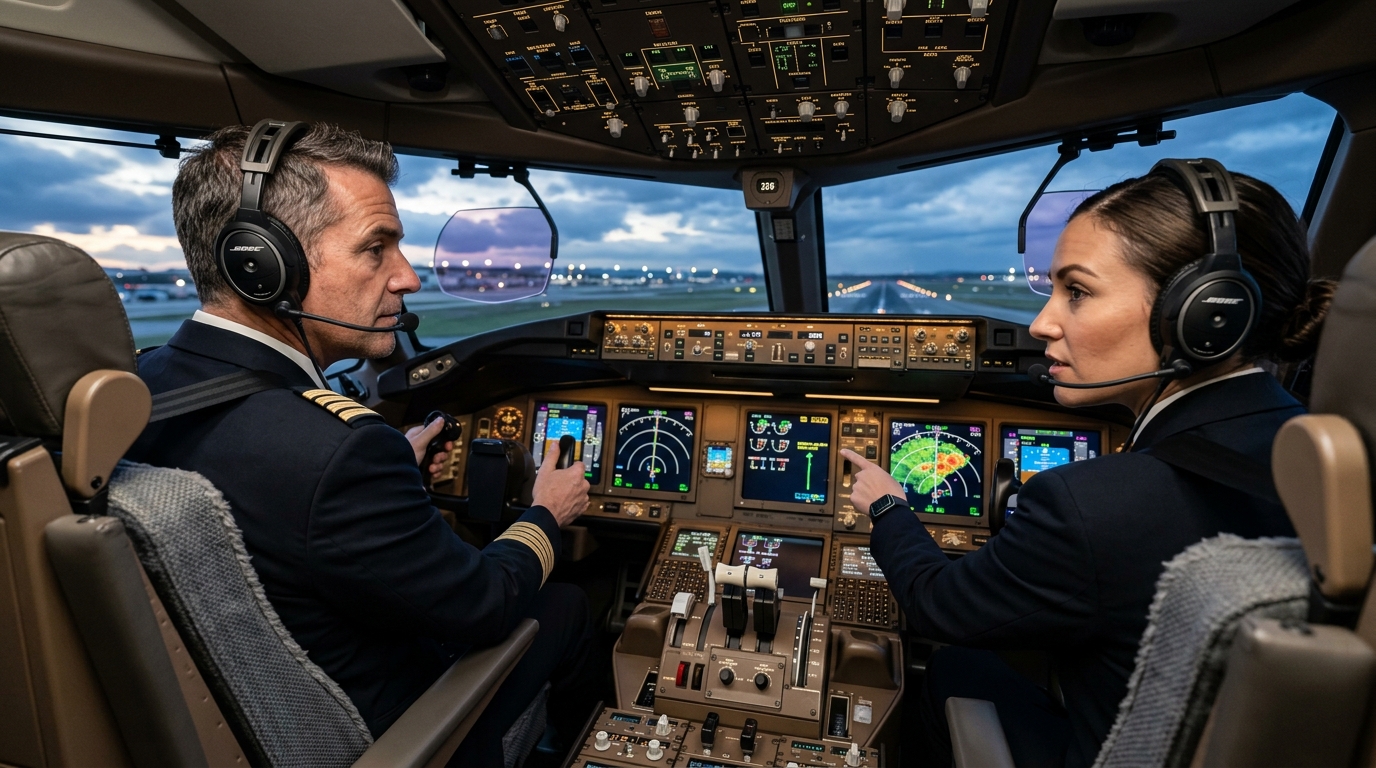
Human factors are central to Crew Resource Management Tools because aviation incidents rarely come from one dramatic mistake alone. ICAO’s CRM guidance emphasizes situation awareness, teamwork, task allocation, and decision-making and error management. FAA guidance similarly describes CRM as the effective use of all available resources: human resources, hardware, and information. That broad definition matters because safety problems usually appear in the gap between people, tools, and information.
Error management is not about expecting perfection. It is about expecting slips and building a process that catches them early. Crew Resource Management Tools help the crew do that by making it normal to verify, cross-check, and ask for confirmation. When the system assumes humans can drift, it designs for recovery rather than denial. That is a more realistic and more stable safety philosophy than pretending mistakes will never happen.
One important human-factors lesson is that distractions are never neutral. They may be small, but they can move attention away from a cue that mattered. FAA monitoring guidance says effective monitoring requires managing distractions and remaining vigilant. Crew Resource Management Tools make that easier by giving the crew a shared plan for where attention should go first and how to call it back when it wanders.
When crews use Crew Resource Management Tools well, they also reduce fatigue-driven errors in a practical way. A fatigued person is more likely to miss a detail or assume something has already been checked. A well-coordinated crew can compensate by redistributing workload, speaking up sooner, and using standard calls to reduce memory load. That teamwork does not eliminate fatigue, but it can make the risk more manageable.
Automation, mode awareness, and modern operations
Modern aircraft are increasingly automated, which makes Crew Resource Management Tools even more important. FAA guidance on SOPs and pilot monitoring says monitoring standards matter especially with modernized automated systems. Automation can be helpful, but it also creates new ways to become overconfident or to lose mode awareness. CRM helps the crew stay mentally engaged with what the automation is actually doing.
In an automated cockpit, Crew Resource Management Tools help prevent passive flying. The crew cannot assume the machine will handle everything correctly without oversight. Effective monitoring means the crew is still watching trends, deviations, and changes in trajectory or energy. That active oversight is part of the safety net. It is also a reminder that automation does not replace human judgment; it changes where the judgment is needed most.
Automation also increases the need for precise communication. If a mode changes, the crew should know it and say it out loud. Crew Resource Management Tools support that habit by normalizing explicit confirmation. A crew that talks clearly about automation is less likely to be surprised by it. That is one of the most practical reasons CRM remains critical in modern operations.
A related point is that attention can drift even when the aircraft is stable. The aircraft may look calm while the crew’s awareness quietly narrows. Crew Resource Management Tools keep the crew cognitively active by requiring a shared scan of the situation. In this way, CRM works like a mental anti-drift device. It keeps the flight from becoming autopilot in the human sense as well as the mechanical one.
When to speak up and how to challenge
One of the most valuable Crew Resource Management Tools is the habit of speaking up early. A crew member should not wait until uncertainty turns into a clear problem. Early, respectful challenge gives the team more options. That does not mean confrontation. It means using a normal process to surface information that may improve the flight path or reduce risk.
The hardest part is often emotional, not technical. People sometimes hesitate because they do not want to seem difficult or because they assume the other person already noticed. Crew Resource Management Tools reduce that hesitation by making challenge a routine safety behavior. If the team expects questions, then questions become easier to ask. That shift can save time and prevent silence from becoming a hazard.
Challenge works best when the language is short and specific. Instead of vague concern, the crew should use words that point to the exact issue: altitude, speed, mode, configuration, or runway. Crew Resource Management Tools are about precision, not drama. Precise language helps the other person respond quickly and keeps the conversation useful even when workload is high.
That habit also strengthens sound cockpit judgment because the decision is no longer trapped inside one person’s head. The crew can compare observations, identify the best option, and act with better confidence. Crew Resource Management Tools therefore improve decision quality not by replacing the pilot, but by making the pilot less alone in the moment that matters.
Role clarity across the crew and related teams
Good aviation teamwork does not stop with the cockpit. ICAO CRM guidance explicitly includes other personnel essential to flight safety, and FAA CRM guidance notes that the training is intended for flight crewmembers and other people whose roles support safe operations. That broader view matters because Crew Resource Management Tools work best when the full system shares expectations about timing, communication, and responsibility.
When role clarity is strong, each person knows what they own and what they should verify. That lowers confusion during normal operations and makes irregular operations easier to handle. Crew Resource Management Tools reduce duplicated effort and remove the danger of assuming someone else handled a task. Clear responsibility is not bureaucracy; it is one of the simplest forms of risk control.
That principle is especially important during transitions between phases of flight. Takeoff, climb, cruise, descent, approach, and landing all change the crew’s attention needs. Crew Resource Management Tools help the team reset as those phases change so the work does not rely on stale assumptions. A clean transition is often what separates a smooth flight from one that feels rushed and unstable.
Teams that value professional mastery tend to take role clarity seriously because skill shows up most clearly when the workload is uneven. One crewmember may be handling radios while another flies, but both remain responsible for the bigger picture. Crew Resource Management Tools make that shared responsibility operational rather than abstract.
Real-world application and practical analogy
CRM thinking also helps outside the cockpit because it teaches people to manage resources, speak early, and verify assumptions. That mindset can even be compared to choosing Cold Countries to Visit in June or July: the best choice is not the loudest or most dramatic option, but the one that best matches the conditions and your comfort with them. Crew Resource Management Tools work the same way. They fit the environment first.
Similarly, a Summer Holiday Without Heatwave is usually the result of planning, timing, and good information rather than luck. The aviation parallel is simple: good outcomes come from matching the plan to the reality of the situation. Crew Resource Management Tools make that matching process visible, which is why they are useful far beyond training slides. They encourage people to think before acting and to coordinate before conditions become difficult.
A practical table for safety use
| CRM area | What good looks like | Why it helps |
|---|---|---|
| Briefing | Shared threats, roles, and changes | Builds a common mental model |
| Monitoring | Active watching and clear callouts | Catches deviations early |
| Communication | Short, precise, respectful language | Reduces confusion |
| Workload | Tasks distributed before saturation | Prevents overload |
| Challenge | Early, calm questioning | Surfaces risk before it grows |
| Debrief | Honest review and feedback | Reinforces learning |
The table above is another way to see how Crew Resource Management Tools turn theory into action. Each area links a crew behavior to a safety benefit, and the pattern is consistent across FAA and ICAO guidance: the stronger the structure, the safer the operation tends to be.
Building a stronger safety habit
The most successful crews do not rely on memory alone. They rely on repetition, structure, and accountability. Crew Resource Management Tools help create that habit by making safety visible in ordinary work. A checklist, a briefing, a monitoring callout, and a debrief may seem small individually, but together they produce a much more robust safety culture. That culture is what makes the protocol durable.
Consistency matters because crews often perform well when the day is easy but slip when the day is busy. Crew Resource Management Tools reduce that inconsistency by making the right action the expected action. When standards are clear, people spend less time guessing what to do and more time doing it. That is one of the biggest reasons standardized teamwork outperforms ad hoc teamwork in complex environments.
In that sense, Crew Resource Management Tools are a disciplined form of care. They protect passengers, protect crew, and protect the operation from small communication failures that can snowball. They do not replace skill. They make skill more reliable. And in aviation, reliability is not a bonus feature. It is the center of the whole safety system.
Sustaining the habit over time
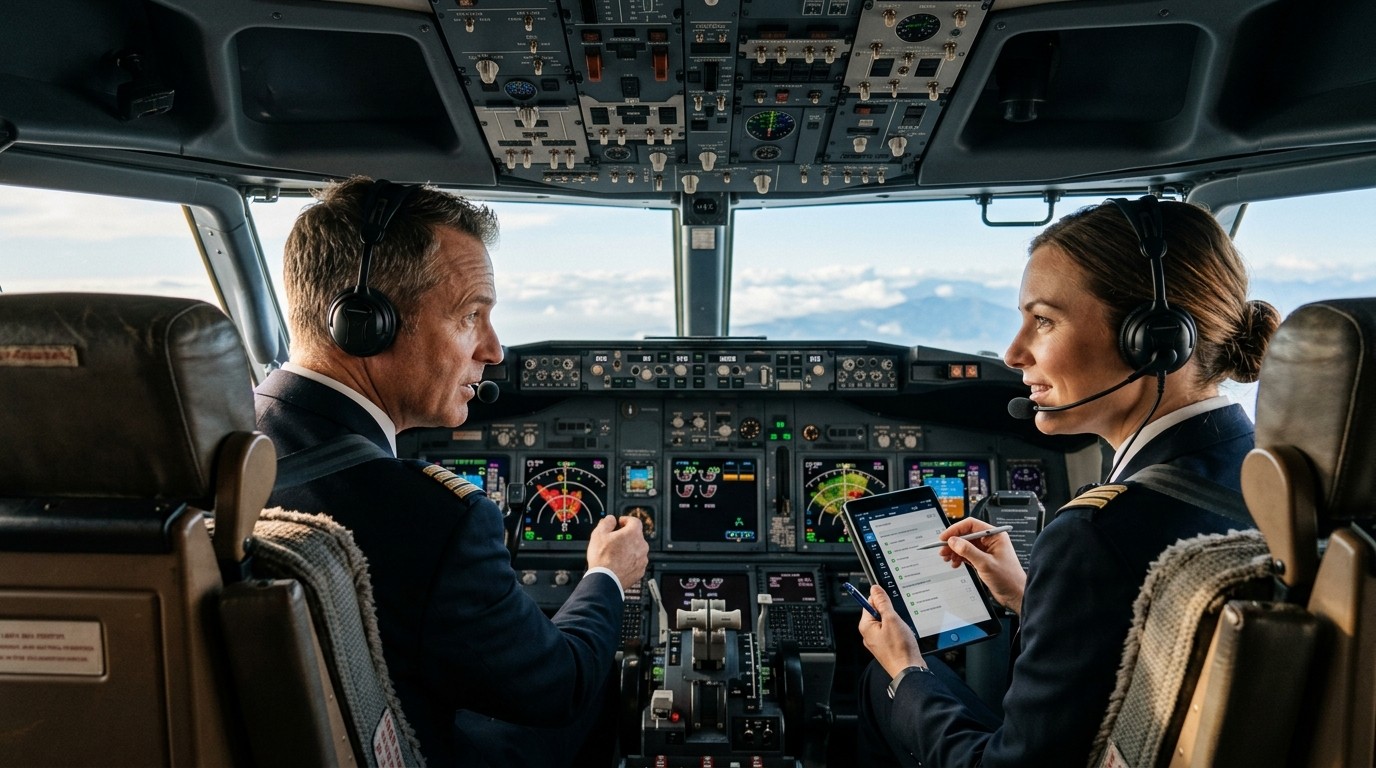
The hardest part of any safety protocol is not learning it once; it is keeping it alive when the schedule becomes normal and the crew starts to feel comfortable. That is where weekly repetition, short feedback, and visible leadership matter. A crew that reviews one small lesson after each flight usually learns more than a crew that waits for a rare major event. The same is true for training events: the most useful reviews are specific, honest, and tied to an actual behavior the crew can improve next time. FAA and ICAO guidance both support CRM as something that should be reinforced and assessed, which means the system should keep producing reminders even when everything is going well. If the crew can make review feel ordinary, then improvement becomes ordinary too. That is the point at which the protocol stops being a course and starts becoming a culture.
A brief, structured debrief after landing helps crews notice patterns while the details are still fresh, which makes small corrections easier to carry into the next sector.
This keeps learning practical, timely, and easier to repeat.
Conclusion
Crew Resource Management Tools are most effective when they are treated as everyday safety behavior rather than special-event training. FAA and ICAO guidance show that CRM should be woven into SOPs, monitoring, communication, workload management, and decision making so crews can use human resources, hardware, and information more effectively. When the team briefs clearly, challenges early, monitors actively, and debriefs honestly, the operation becomes safer and more resilient. That is why Crew Resource Management Tools remain central to modern aviation: they help people do complex work with more clarity, more coordination, and fewer preventable surprises.
Frequently Asked Questions (FAQ)
1. What are Crew Resource Management Tools?
Crew Resource Management Tools work by giving crews a repeatable way to brief, monitor, communicate, and verify actions so safety does not depend on memory alone. FAA and ICAO guidance both treat CRM as part of normal training and operations.
2. Why are SOPs so important in CRM?
SOPs give Crew Resource Management Tools a stable structure. FAA guidance says SOPs are fundamental to safe aviation operations and should be clear, comprehensive, and readily available to crewmembers.
3. How does monitoring improve safety?
Crew Resource Management Tools improve safety by making monitoring a defined duty. FAA guidance says effective monitoring includes following SOPs, communicating deviations, managing distractions, and remaining vigilant.
4. Why does leadership matter so much?
Good leadership makes Crew Resource Management Tools easier to use because the tone set by the PIC shapes whether the crew speaks up, verifies, and stays aligned. FAA leadership guidance ties command skills to professionalism and SOP adherence.
5. How do these tools help sound cockpit judgment?
Crew Resource Management Tools work by slowing the moment down enough for the crew to share observations, rank options, and verify assumptions before acting. That makes Pilot Decision Making more deliberate and less isolated.
6. Do these tools still matter with automation?
Yes. Crew Resource Management Tools matter more, not less, because FAA guidance notes that monitoring and SOP discipline are especially important with modernized automated systems.
7. What makes a good crew briefing?
A good briefing uses Crew Resource Management Tools to create one shared picture of the flight: threats, roles, expected changes, and where extra attention will be needed. ICAO and FAA guidance both emphasize shared awareness and team coordination.
8. Why is challenge-response communication useful?
Crew Resource Management Tools rely on challenge-response communication because it helps surface risk early, before uncertainty becomes an operational problem. Respectful challenge is a safety behavior, not a sign of conflict.
9. How often should CRM be reinforced?
Crew Resource Management Tools should be reinforced continuously through training, line operations, and debriefs. FAA and ICAO guidance both say CRM should be developed, implemented, reinforced, and assessed.
10. What is the biggest benefit of CRM?
The biggest benefit of Crew Resource Management Tools is that they help crews catch problems earlier and make safer decisions under pressure without depending on perfect human performance.