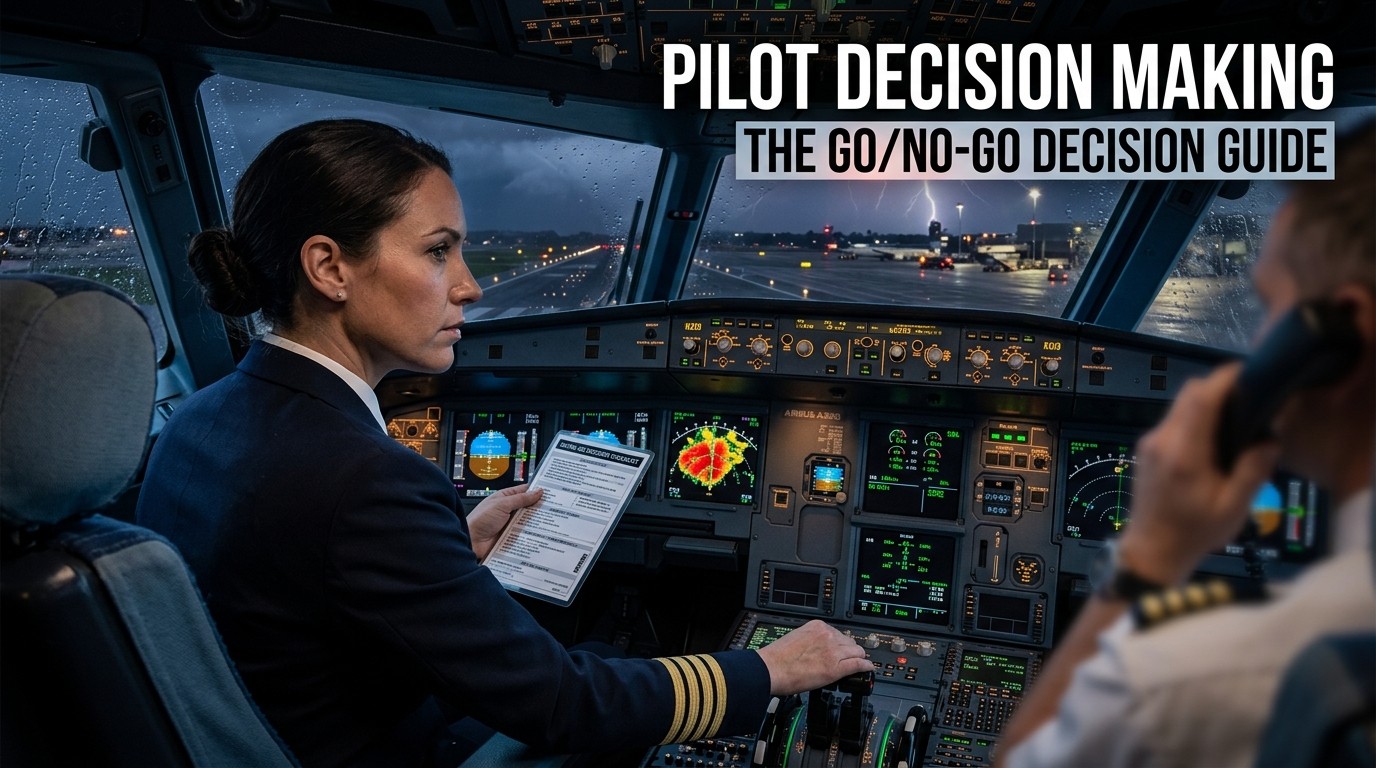
Pilot Decision Making improves when pilots slow down, check risk honestly, and use a repeatable go/no-go process that protects the flight before pressure, fatigue, or weather can narrow judgment.
Pilot Decision Making is the point where planning becomes commitment. Before the wheels move, the pilot has already collected weather, fuel, aircraft, route, and personal readiness information. The go/no-go choice is where that information turns into action, delay, reroute, or cancellation.
Pilot Decision Making is often misunderstood because people judge it by the outcome instead of the reasoning. A flight that never launched because the weather was marginal or the pilot was too tired can be a strong decision. A flight that happened only because the pressure felt louder than the warning signs may be weak judgment, even if it ended without an incident.
FAA guidance treats Aeronautical Decision Making as a systematic approach to risk assessment and stress management, and it highlights the PAVE checklist for evaluating Pilot, Aircraft, EnVironment, and External pressures. FAA safety material also says Flight Risk Assessment Tools can help pilots identify hazards early and support better go/no-go decisions.
Pilot Decision Making becomes clearer when it is treated as a discipline instead of a gut feeling. A disciplined pilot asks, “What is the mission, what can change, and what margin remains if something gets worse?” That one habit turns the whole decision into a calmer, more defensible process.
The human side of bad decisions
Pilot Decision Making is rarely defeated by one giant mistake. More often, it is weakened by a stack of small mental pressures. People want to be reliable, avoid disappointing others, and finish what they started. Those are normal human tendencies, but they can quietly push a pilot toward launching when the safer answer is to wait.
Pilot Decision Making also gets distorted by optimism. A pilot may assume the ceiling will improve, the wind will settle down, or the route will remain manageable because a delay already happened once. That kind of hopeful thinking feels harmless, but it can make a risky plan feel more acceptable than it really is.
Pilot Decision Making becomes more reliable when the pilot notices those emotional patterns early. Once the pressure is named, it is easier to separate the mission from the ego. The best pilots are not the ones who never feel pressure; they are the ones who recognize it before it starts driving the decision.
Personal minimums make judgment visible
Pilot Decision Making improves when personal minimums are written down before stress arrives. FAA PAVE guidance explicitly reminds pilots that there is a difference between what is legal and what is smart or safe, and it encourages setting personal limits, especially around weather and crosswind conditions.
Pilot Decision Making becomes more honest when those minimums reflect real experience instead of wishful thinking. A pilot who is not current in night flying should not pretend to have the same night comfort as someone who flies at night every week. A pilot who has little mountain experience should not use the same weather tolerance as a pilot who knows the route intimately.
Pilot Decision Making should also change as experience changes. A pilot who gains proficiency, logs new training, or switches aircraft may be able to raise some limits and tighten others. That is not inconsistency. It is healthy adaptation. Good judgment grows when the minimums stay current rather than becoming old habits that no longer fit the pilot’s actual skill set.
A framework beats a feeling
Pilot Decision Making works best when it follows a framework. Structured thinking is stronger than instinct alone because it forces the pilot to compare multiple risks instead of focusing on the easiest one. A bright sky can hide a fatigued pilot. A very capable aircraft can still be a bad match for the mission. A simple mental checklist keeps the whole picture visible.
Pilot Decision Making becomes more objective when the same sequence is used every time. The order may vary, but the habit should remain consistent: pilot readiness, aircraft readiness, environment, and external pressure. When that sequence is repeated, it becomes much harder for one attractive detail to hide a more serious issue.
Pilot Decision Making is not just about deciding whether to take off. It is also about deciding whether the original plan still makes sense. A shorter route, an alternate airport, a later departure, or an overnight stay can all be part of a wise decision. The best process does not force a yes; it finds the correct answer.
Pilot factor : how the pilot state changes everything
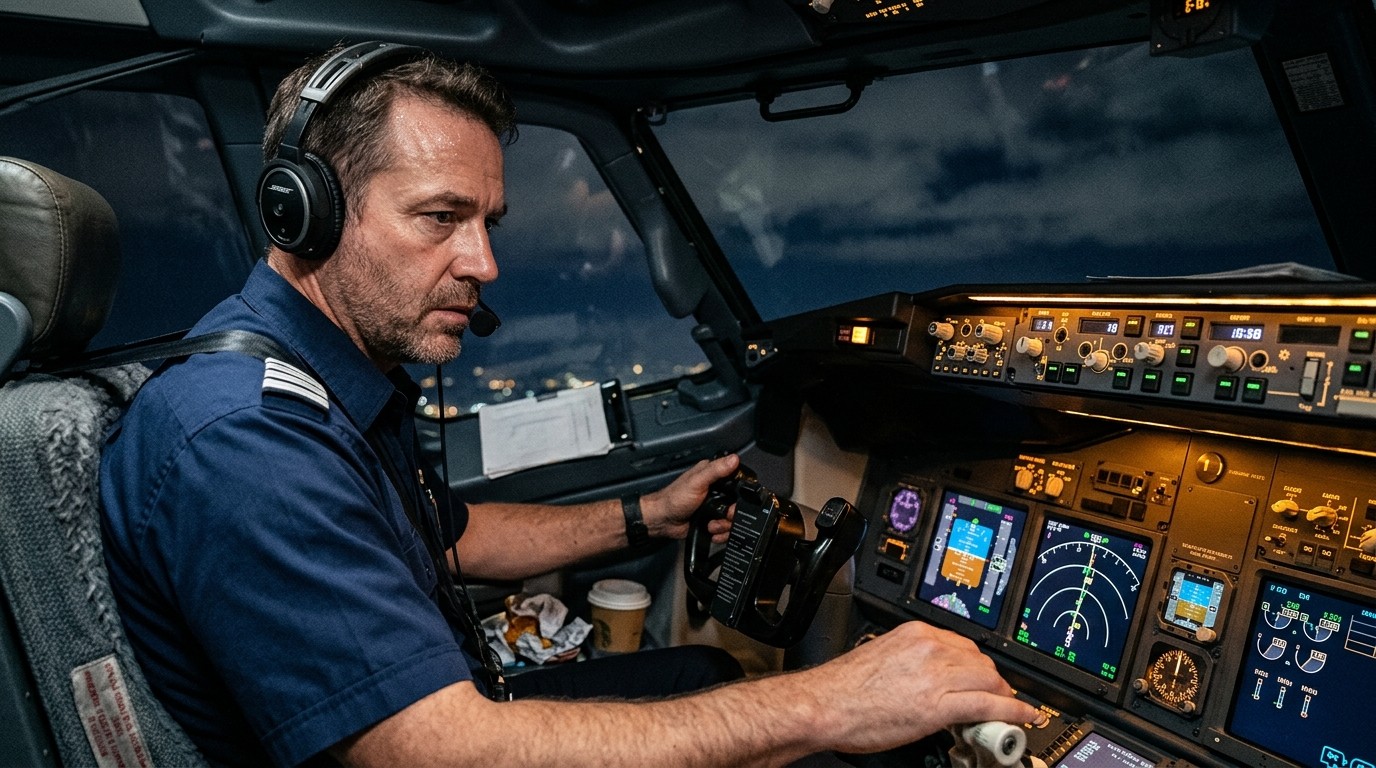
Pilot Decision Making has to begin with the pilot, because an airplane cannot compensate for a pilot who is not ready. FAA PAVE guidance asks whether the pilot is ready in terms of experience, recency, currency, physical condition, and emotional condition, and it points to the IMSAFE checklist as a way to assess those personal factors.
Pilot Decision Making should ask difficult questions here. Did you sleep enough? Are you sick? Are you distracted by work, money, family, or conflict? Are you fatigued from earlier duties? Did you eat? Did you drink alcohol recently? A single weak answer can be enough to justify delay.
Pilot Decision Making also depends on specific recency, not just broad total hours. A pilot may be current in the aircraft but not current in crosswinds, night landings, short fields, or mountain terrain. Those are different skills. The safest decision recognizes that “current” and “comfortable” are not the same thing.
Pilot Decision Making gets even stronger when the pilot admits emotional pressure. Irritation, embarrassment, overconfidence, and the desire to prove something all lower the quality of judgment. The key is not to become emotionless. The key is to stop pretending that emotion is irrelevant.
Aircraft factor: the machine must fit the mission
Pilot Decision Making gets sharper when the aircraft is treated as a mission constraint, not simply a means of transportation. FAA PAVE guidance asks whether the aircraft is the right one for the flight, whether the pilot is current in that aircraft, whether it is equipped for the mission, whether it can handle the runway, altitude, and load, and whether fuel reserves remain adequate.
Pilot Decision Making should include performance margins, not just legal minimums. A runway that technically works may still be too tight once weather, density altitude, weight, slope, or contamination are considered together. Smart pilots think in buffer, not just compliance.
Pilot Decision Making should also consider maintenance status and equipment fit. An aircraft can be airworthy and still poorly suited for the route. If the mission demands weather tools, deicing capability, lighting, or navigation equipment that the aircraft lacks, the safer answer may be no even when the paperwork is in order.
Pilot Decision Making is usually better when the aircraft choice is made honestly at the start. A trip that pushes the plane toward its edge tends to push the pilot toward worse judgment too. Matching aircraft to mission is a form of risk reduction before the risk even starts moving.
Environment factor: weather, terrain, and airports
Pilot Decision Making becomes much more grounded when the environment is treated as dynamic. Weather is not a static label. It includes ceilings, visibility, wind, thunderstorms, icing, terrain, and airport conditions. FAA guidance advises pilots to consider that weather may differ from the forecast and to prepare alternate plans accordingly. It also warns that mountainous terrain can create severe turbulence and downdrafts even without other significant weather.
Pilot Decision Making should also account for altitude and terrain. FAA guidance advises pilots to determine safe altitudes in advance, use charts and maximum elevation figures, and check NOTAMs for runway closures, lighting problems, and other airport issues that affect arrival or departure.
Pilot Decision Making becomes more conservative in unfamiliar terrain for a reason. A new route can make visual cues harder to interpret, especially when the weather changes. What looked easy in planning can become uncomfortable in flight if the winds shift or the ceiling drops. That is why local knowledge and route planning matter so much.
Pilot Decision Making also changes with time of day. A trip that looks acceptable in the morning may become questionable after convection develops. A return that feels fine in daylight may become much harder after dark. The environment is not just the place; it is also the moment.
External pressure: the silent risk factor
Pilot Decision Making is often distorted by pressure that has nothing to do with flying skill. Passengers may be waiting. A meeting may begin at a fixed time. A family plan may depend on arrival. None of that changes the weather, but it can change how willing the pilot is to say no.
Pilot Decision Making becomes stronger when pressure is named directly. Once the pilot says, “I want to go because people expect me to,” the decision becomes easier to inspect. That is not weakness. It is clarity. Safety improves when the pilot can see the pressure before the pressure sees the pilot.
Pilot Decision Making also needs a stop rule. If the only reason to depart is convenience, the mission is already weaker. If the trip still feels important after pressure is removed from the picture, it deserves a deeper review. Delay, diversion, and cancellation are not failures; they are legitimate outcomes of a sound process.
Using risk tools without turning them into rituals
Pilot Decision Making becomes more repeatable when formal risk tools are used. A Flight Risk Assessment Tool is not magic and it does not decide for the pilot. It organizes hazards, shows patterns, and helps compare the mission against a threshold. FAA material says FRATs facilitate proactive hazard identification and support better go/no-go decisions.
Pilot Decision Making gains discipline when the score is honest. A pilot may feel “mostly okay” about a flight, but a risk tool can reveal that several moderate issues combine into something meaningfully higher. That matters because risk is often cumulative. One small factor rarely ends the mission, but five small factors can.
Pilot Decision Making should use FRATs early, not at the runway. FAA risk material emphasizes that in the thick is not the time to try to mitigate a hazardous outcome. The purpose of preflight risk tools is to detect problems while the pilot still has time to choose differently.
PAVE in real life

Pilot Decision Making becomes practical when the PAVE checklist is used as a working habit rather than a poster on a wall. The pilot asks: what is happening with me, the aircraft, the environment, and the outside pressure right now? If even one category is weak, the flight deserves a more careful look.
Pilot Decision Making gets better when the answers are written down in a few plain words. A note like “tired, strong crosswind, unfamiliar airport, passengers pressed for time” is more useful than a vague feeling that everything will probably work out. Writing forces honesty, and honesty is the backbone of safe judgment.
Pilot Decision Making should also include the mission shape. A short local hop may be acceptable under conditions that would make a cross-country trip unwise. A daytime VFR leg may be fine while a night return in the same weather may not. The question is not “Is this flight possible?” The question is “Is this version of the flight still smart?”
IMSAFE as a gate, not a suggestion
Pilot Decision Making becomes stronger when IMSAFE is treated as a hard gate. Illness, medication, stress, alcohol, fatigue, and eating all influence reaction time, judgment, and workload tolerance, and FAA guidance points pilots toward IMSAFE when assessing personal readiness.
Pilot Decision Making should ask whether the pilot is simply legal or actually ready. A person may be legal to fly and still be too tired, too distracted, or too emotionally depleted to perform well. The logbook may say yes while the body and mind quietly say no.
Pilot Decision Making improves when the pilot also thinks about food and hydration. Low energy does not always feel dramatic, but it can reduce patience and concentration in ways that matter in the cockpit. Sometimes the safest decision begins with rest, a meal, a delay, or a quiet reset before the flight even gets serious.
CRM and SRM: making use of every available resource
Pilot Decision Making is not just for multi-crew cockpits. FAA guidance on crew resource management describes CRM as the application of team management concepts in the flight deck, and the FAA’s glossary notes that the idea includes single pilots as well. In practical terms, general aviation pilots also use single-pilot resource management, or SRM, to manage all onboard and outside resources before and during flight.
Pilot Decision Making becomes more reliable when the pilot uses every available resource instead of relying on memory alone. That can include ATC, weather briefings, airport charts, a dispatcher, a mentor, aircraft automation, and onboard systems. The goal is to reduce blind spots before they turn into errors. FAA’s SRM guidance says structured SRM helps pilots gather information, analyze it, and make sound decisions about the flight.
Pilot Decision Making can also benefit from a conversation with another experienced person. A second set of eyes often notices a risk the pilot has normalized. That is why brief mentoring, dispatch support, or instructor feedback can be so valuable. Good judgment is not just internal confidence; it is the willingness to test that confidence against reality.
Crew Resource Management Tools in a solo cockpit
Pilot Decision Making may feel solitary, but it should not be isolated. Crew Resource Management Tools can still help a single pilot by structuring communication, workload sharing, and situational awareness. Even alone in the aircraft, the pilot can still manage the cockpit like a team by assigning priorities and using checklists deliberately.
Pilot Decision Making becomes easier when tasks are mentally distributed. A pilot can plan in advance which tool will handle navigation, which tool will handle weather, which source will handle route updates, and which trigger will prompt a diversion discussion. That keeps the workload from collapsing into one overloaded moment.
Pilot Decision Making also benefits from a simple rule: one task at a time. This reduces confusion, helps the pilot avoid channeling too much attention into one problem, and keeps the mental model stable when workload rises.
Scenario thinking: what wise pilots do before launching
Pilot Decision Making should be tested against scenarios instead of abstract theory. Imagine a weekend VFR flight with a passenger, marginal ceilings, and a return planned after sunset. The aircraft is capable, but the weather trend is not clean and the pilot feels a little rushed. In that moment, the wise choice may be delay, a shorter trip, or an overnight stop.
Pilot Decision Making in that situation should resist the phrase “good enough.” If the whole plan only works when nothing gets worse, the plan is too fragile. The safest mission usually has enough margin to survive one small surprise. That is what makes a flight feel manageable rather than merely possible.
Pilot Decision Making can also be tested by a mountain-airport scenario. The route is legal, the aircraft is capable, and the day looks decent on paper, but winds aloft, terrain, and runway length combine to create little room for error. A conservative no-go choice there is not fear. It is sound risk management.
Pilot Decision Making works best when the pilot imagines the next complication before it happens. What if the wind shifts? What if the ceiling lowers? What if the delay creates a night arrival instead of a day landing? The safest answer is usually the one that still looks acceptable after the next variable is added.
Digital support without surrendering judgment
Pilot Decision Making can benefit from technology, but technology should support the pilot rather than replace the pilot. Top Travel Apps can help organize itineraries, hotel timing, ground transport, and connection details so the preflight mind is less cluttered and more focused on the flight itself.
Pilot Decision Making can also improve with Best Flight Tracking Apps because they help monitor delays, reroutes, weather impacts, and traffic flow. Those tools do not make the decision for the pilot, but they can reduce uncertainty and make the review more informed. The important point is that data is a support layer, not a substitute for judgment.
Pilot Decision Making should never become app-driven autopilot for the brain. A screen can warn, but it cannot weigh the pilot’s fatigue, the family pressure, the aircraft margin, and the mission value at the same time. The pilot still has to integrate the facts into one clear answer.
Building better judgment over time

Pilot Decision Making is not one skill that gets mastered in a single step. It is a pattern built through repetition, reflection, and correction. Every flight gives the pilot a chance to notice what mattered, what was ignored, and what risk looked smaller than it really was.
Pilot Decision Making becomes part of Aviation Mastery when the pilot studies restraint as seriously as stick-and-rudder skill. Mastery is not only about smooth landings and clean climbs. It is also about knowing when not to launch, when to reroute, and when to stop defending the original plan.
Pilot Decision Making should be reviewed after the flight as well. A no-go decision that protected the day deserves as much attention as a successful departure. A marginal flight that got through safely should also be reviewed carefully. The goal is not shame. The goal is to build better future judgment.
A simple go/no-go workflow
Pilot Decision Making gets easier when the same order is used each time. Start with the mission. Then check the pilot, the aircraft, the environment, and the external pressure. Then compare the whole picture against personal minimums or a formal risk score. End with one of three answers: go, delay, or revise.
Pilot Decision Making becomes stronger when the decision is stated clearly. “We are going because the margins are good” is better than “I guess it should be okay.” “We are not going because the risk stack is too high” is better than “I have a bad feeling.” Clear language helps the pilot stay honest.
Pilot Decision Making is also easier when delay is treated as normal. The safest pilots are not the ones who always depart. They are the ones who know when not to. That is the line between confidence and compulsion, and it is one of the most important skills in aviation.
A quick way to think about the whole process
Pilot Decision Making can be reduced to a few questions. Is the pilot ready? Is the aircraft ready? Is the environment cooperative? Is the pressure real or emotional? If one answer is weak, does the remaining margin still make the flight wise? If the answer is fuzzy, the pilot should slow down and reassess.
Pilot Decision Making becomes much safer when the pilot stops asking only “Can I do this?” and starts asking “Should I do this today, in this form, with these margins?” That change in wording is small, but it often changes the result. Good judgment happens when the decision is honest about both ability and risk.
Pilot Decision Making improves when the pilot recognizes that refusing a flight is also part of flying. It is a professional move, not a defeat. Sometimes the smartest launch is the one that never happens because the pilot respected the limits that mattered most.
Conclusion
Pilot Decision Making is a discipline built on honesty, structure, and margin. The best go/no-go choices come from checking the pilot, the aircraft, the environment, and the pressure around the mission before the engine starts. FAA guidance supports that style of thinking through Aeronautical Decision Making, PAVE, IMSAFE, FRAT, and SRM, all of which push pilots toward structured risk awareness and calmer judgment. When those tools are used seriously, the cockpit feels less reactive, the plan becomes clearer, and the final answer is easier to trust. That is the real value of good decision making: not just safer flights, but more confident and controlled ones.
Frequently Asked Questions (FAQ)
1. What is Pilot Decision Making?
Pilot Decision Making is the process of evaluating risk, readiness, weather, aircraft status, and pressure before deciding whether a flight should go ahead.
2. What does go/no-go mean?
Go/no-go is the decision point where the pilot chooses to depart, delay, reroute, or cancel based on current conditions and personal limits.
3. Why is personal minimums important?
Personal minimums turn judgment into something visible and repeatable, so the pilot is not making the decision from stress or optimism in the moment. FAA guidance encourages this approach.
4. What does the PAVE checklist cover?
PAVE covers Pilot, Aircraft, EnVironment, and External pressures. FAA guidance uses it as a structured preflight risk check.
5. What is IMSAFE?
IMSAFE stands for illness, medication, stress, alcohol, fatigue, and eating. FAA material points pilots toward IMSAFE as part of personal readiness evaluation.
6. What is a FRAT?
A Flight Risk Assessment Tool helps identify hazards early and compare the flight against a risk threshold. FAA says it supports better go/no-go decisions.
7. Do single pilots use CRM ideas too?
Yes. FAA guidance notes that CRM concepts apply to single pilots as well, through SRM and resource management.
8. Why does weather matter so much?
Weather changes the risk picture quickly, especially with terrain, wind, visibility, and icing. FAA guidance specifically warns that mountainous terrain can add turbulence and downdraft hazards.
9. Can apps help with the decision?
Yes, but only as support tools. Top Travel Apps and Best Flight Tracking Apps can reduce distraction and improve awareness, while the pilot still makes the actual call.
10. What is the best habit for safer decisions?
Use the same structured preflight process every time, review your personal minimums often, and be willing to delay or cancel when the margin is not strong enough.