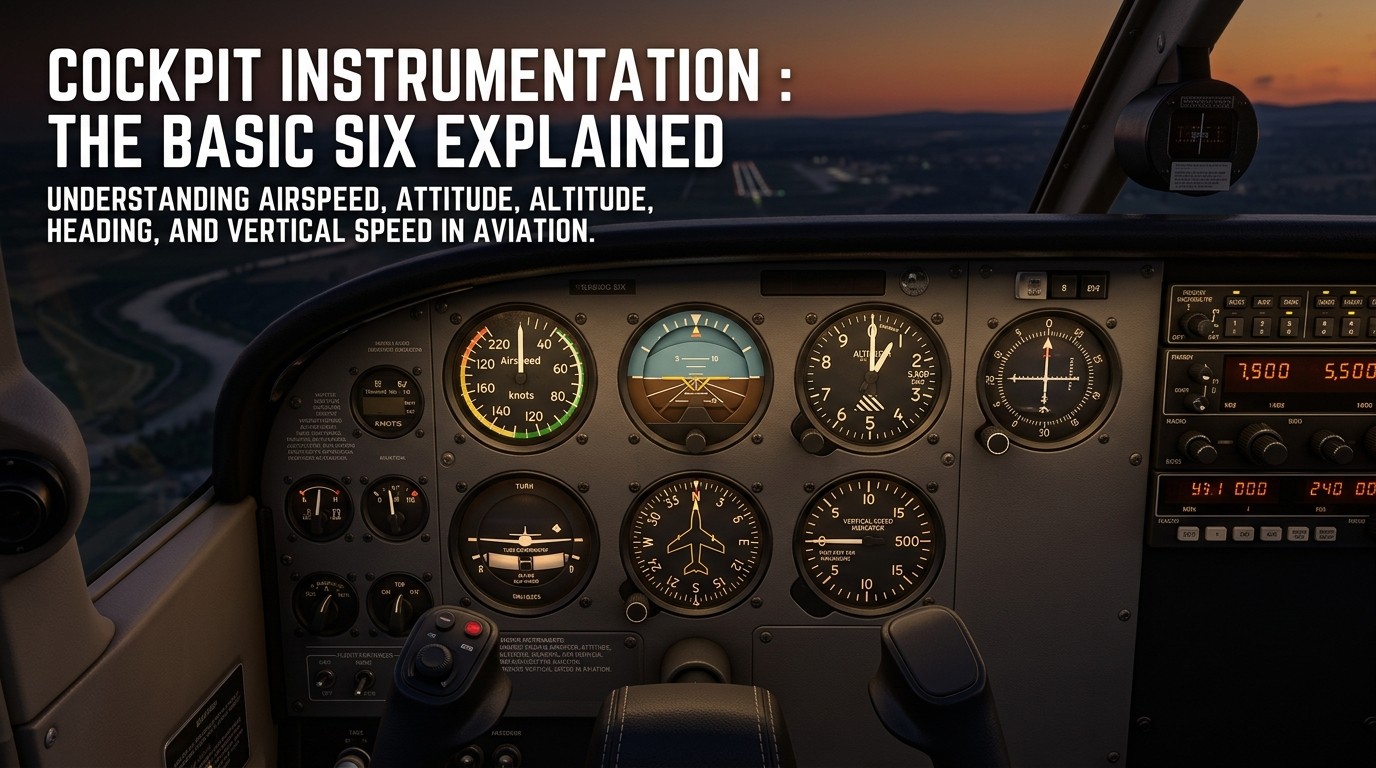
Cockpit Instrumentation gives pilots the core information needed to control attitude, altitude, direction, speed, and engine health with confidence during every phase of flight, from takeoff to landing.
Cockpit Instrumentation is the visual language of flight. Every needle, pointer, digital tape, and warning light exists for one purpose: to help the pilot understand what the aircraft is doing right now and what it is likely to do next. For a new learner, the panel may look crowded, but the six primary flight instruments are designed to answer the most important questions first. Is the aircraft climbing or descending? Is it banking? Is it turning? How fast is it moving? How high is it? Is the nose pointed safely toward the intended heading? Once those questions are understood, flying becomes far less mysterious.
Cockpit Instrumentation is often called the “basic six,” because these instruments form the foundation of safe visual and instrument flight. Even when modern glass panels present the data on screens, the underlying logic remains the same. A pilot still needs reliable attitude, airspeed, altitude, vertical speed, and directional awareness. The presentation may change, but the operational goal does not.
Cockpit Instrumentation also helps create a mental discipline that every pilot needs. Instead of guessing, the pilot verifies. Instead of assuming, the pilot scans. Instead of reacting late, the pilot notices early trends. That habit matters in training, in airline operations, in general aviation, and in emergency situations.
Why the Basic Six Still Matter
Cockpit Instrumentation continues to matter because flying is a task of managing multiple variables at once. The pilot must maintain control, monitor navigation, stay ahead of weather, and make decisions under changing conditions. A good instrument scan ties those tasks together. The aircraft may be stable for a moment, but the environment is not stable for long. Wind shifts, turbulence, workload, and distraction can all affect performance. The basic six provide an immediate answer when the pilot needs one.
Cockpit Instrumentation also builds trust. When a pilot understands what each display means and how the systems relate to each other, confidence rises and confusion drops. That does not mean overconfidence. It means informed control. The pilot knows which instrument to check first, which reading to cross-check, and which trend deserves attention.
The Six Primary Instruments
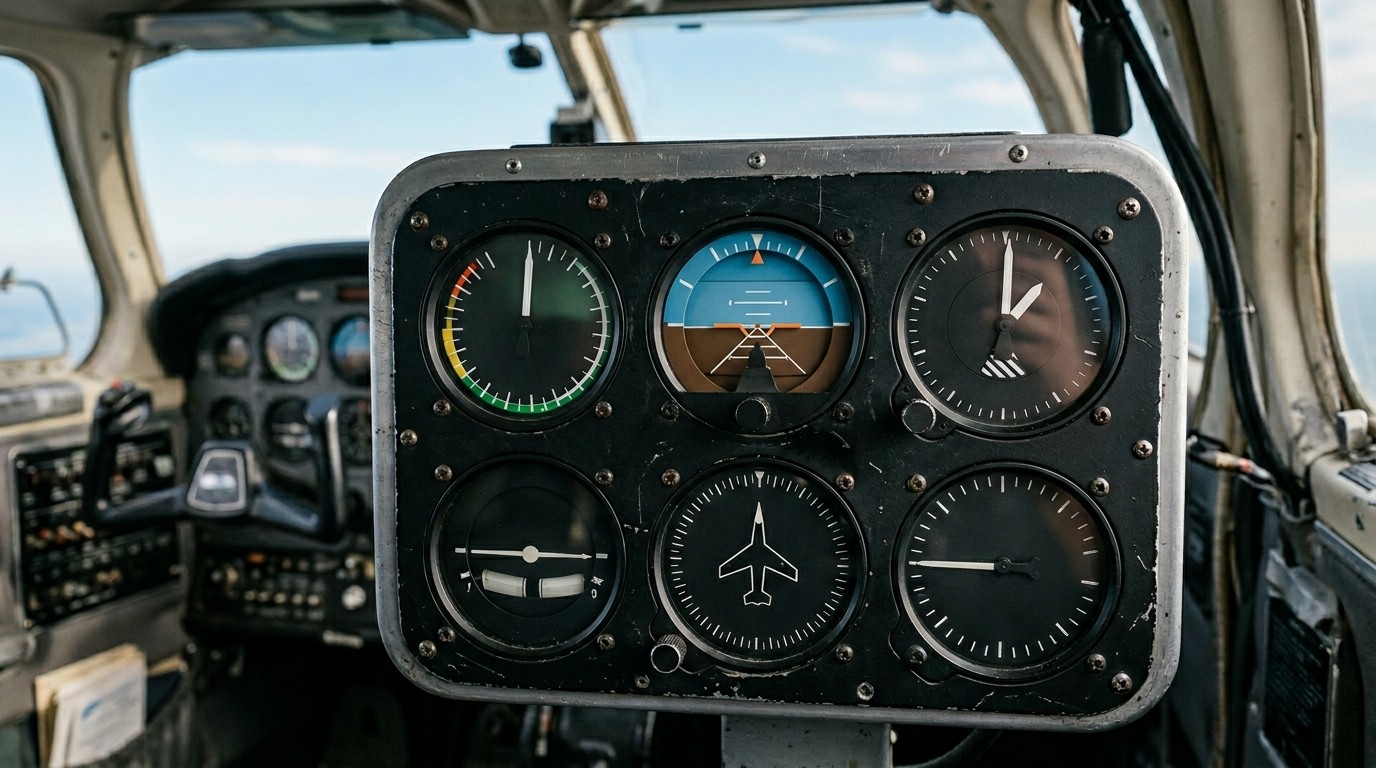
Cockpit Instrumentation is usually organized around the six core flight instruments: airspeed indicator, attitude indicator, altimeter, vertical speed indicator, heading indicator, and turn coordinator or turn-and-slip indicator. These instruments work together rather than separately. One tells you how fast the aircraft moves through the air. Another shows whether the nose is up or down. Another reveals how high the aircraft is. Another tracks climb or descent. Another gives heading reference. Another helps confirm coordinated turns.
Cockpit Instrumentation matters because each instrument answers a different question, and together they tell a complete story. A single reading can be misleading if it is not interpreted in context. For example, a stable airspeed does not guarantee a stable altitude. A level-looking nose does not always mean wings are level. The six instruments reduce that ambiguity.
1. Airspeed Indicator
Cockpit Instrumentation begins with the airspeed indicator, which shows how fast the aircraft is moving relative to the air mass around it. This is not the same as ground speed. A jet in strong headwind may have a lower ground speed while still maintaining proper airspeed, and that difference matters enormously to lift, stall margin, and control response.
Cockpit Instrumentation uses the airspeed indicator as one of the first safety checks because speed directly affects performance. Too slow, and the wing may lose lift. Too fast, and the aircraft may exceed structural or procedural limits. Pilots learn target speeds for takeoff, climb, approach, and landing, and they use the instrument to verify whether those targets are being met.
2. Attitude Indicator
Cockpit Instrumentation depends heavily on the attitude indicator because it shows the aircraft’s pitch and bank relative to the horizon. This is often the most visually intuitive of the six, especially for students who are still building a feel for flight attitude. If the nose is too high, a stall risk may rise. If the bank angle is too steep, a turn may become unstable or unplanned.
Cockpit Instrumentation makes the attitude indicator central because it helps the pilot maintain control when outside visual cues are weak. Night flying, haze, cloud entry, or featureless terrain can all make the real horizon difficult to see. In those moments, the attitude indicator becomes the pilot’s reference for orientation.
3. Altimeter
Cockpit Instrumentation also includes the altimeter, which shows the aircraft’s altitude above sea level using changes in pressure. Pilots must set the correct pressure reference so the reading is meaningful in the current environment. When that is done correctly, the altimeter becomes a critical tool for terrain clearance, traffic separation, and altitude compliance.
Cockpit Instrumentation uses altitude in more ways than simply “how high are we?” It also helps pilots maintain assigned flight levels, comply with air traffic control instructions, and monitor descent profiles. A small altitude deviation can matter when terrain is close or airspace is tightly controlled.
4. Vertical Speed Indicator
Cockpit Instrumentation includes the vertical speed indicator, which shows whether the aircraft is climbing, descending, or holding a steady altitude. Unlike the altimeter, which tells the present height, the vertical speed indicator reveals the trend. That trend information is useful during approaches, climbs, and level-offs.
Cockpit Instrumentation makes trend information valuable because it helps pilots anticipate rather than merely react. A strong descent rate on final approach may signal that a correction is needed. A climb that is shallower than planned may indicate performance limits or pilot technique adjustments.
5. Heading Indicator
Cockpit Instrumentation relies on the heading indicator to show the aircraft’s directional reference. This instrument is often more stable than the magnetic compass during turns and turbulence, which makes it easier to use for precise control. Pilots reset or cross-check it with the compass as needed.
Cockpit Instrumentation uses heading awareness for navigation, route tracking, and situational awareness. A pilot who understands the heading display can stay aligned with a flight plan, avoid airspace violations, and maintain a clean scan during instrument operations. Direction is one of the easiest things to drift without noticing, especially in poor visibility.
6. Turn Coordinator or Turn-and-Slip Indicator
Cockpit Instrumentation also includes the turn coordinator or turn-and-slip indicator, which confirms the rate and quality of a turn. This instrument helps the pilot see whether the aircraft is turning at the intended rate and whether the turn is coordinated or slipping/skidding.
Cockpit Instrumentation benefits from this instrument because safe flight is not just about turning, but about turning correctly. A coordinated turn preserves efficiency, comfort, and control. For students, the turn coordinator often acts as a bridge between visual flying and instrument discipline.
How the Six Work Together
Cockpit Instrumentation is most useful when the pilot interprets all six instruments as a system. The attitude indicator may show a bank, the airspeed indicator may show accelerating speed, the altimeter may be stable for the moment, and the vertical speed indicator may lag behind. That combination tells a more complete story than any single gauge could.
Cockpit Instrumentation teaches cross-checking because each instrument has strengths and limitations. Some instruments respond quickly. Others lag slightly. Some are affected by pressure, vibration, or system errors. When pilots compare multiple readings, they can identify whether the aircraft is truly changing or whether the panel is reflecting a temporary transition.
The panel also supports the instrument scan. Instead of staring at one display, the pilot moves the eyes in a logical pattern. That scan prevents fixation. It also catches subtle changes before they become major deviations. In real flying, tiny corrections made early are much easier than big corrections made late.
Common Training Mistakes
Cockpit Instrumentation can confuse beginners when they focus on the wrong thing at the wrong time. One common mistake is overreacting to a single instrument without checking the others. Another is chasing the needle too aggressively, which creates oscillations. A third is ignoring the attitude indicator and trying to manage flight purely by speed or altitude.
Cockpit Instrumentation becomes clearer when students learn to trust the scan rather than panic at one reading. Another mistake is forgetting to correct for pressure settings on the altimeter. If the setting is wrong, the altitude reading can mislead the pilot. The same applies when heading references are not cross-checked regularly.
Cockpit Instrumentation also becomes difficult when pilots assume the panel tells the full story without considering aircraft configuration, power, trim, and external conditions. Instruments do not replace judgment. They support it.
Human Factors and Pilot Decision Making
Cockpit Instrumentation is not only about reading numbers; it is about making decisions under pressure. The pilot sees the data, compares it with the expected performance, and decides whether to continue, correct, or abort. That is why training must connect instrument reading with Pilot Decision Making.
Cockpit Instrumentation helps reduce cognitive overload because it simplifies reality into manageable cues. But the pilot still has to decide what those cues mean. Is the descent rate normal for this phase of flight, or is it too aggressive? Is the airspeed stable enough for approach, or is it decaying? Is the heading drift caused by wind, distraction, or a navigation mistake? Good decisions come from interpreting the instruments correctly and in time.
Cockpit Instrumentation also interacts with workload. When the workload rises, people often look at fewer instruments and miss trends. That is why scan discipline matters so much. A calm, repeatable scan supports better judgment, especially in training flights and complex traffic environments.
Weather, Visibility, and External Support
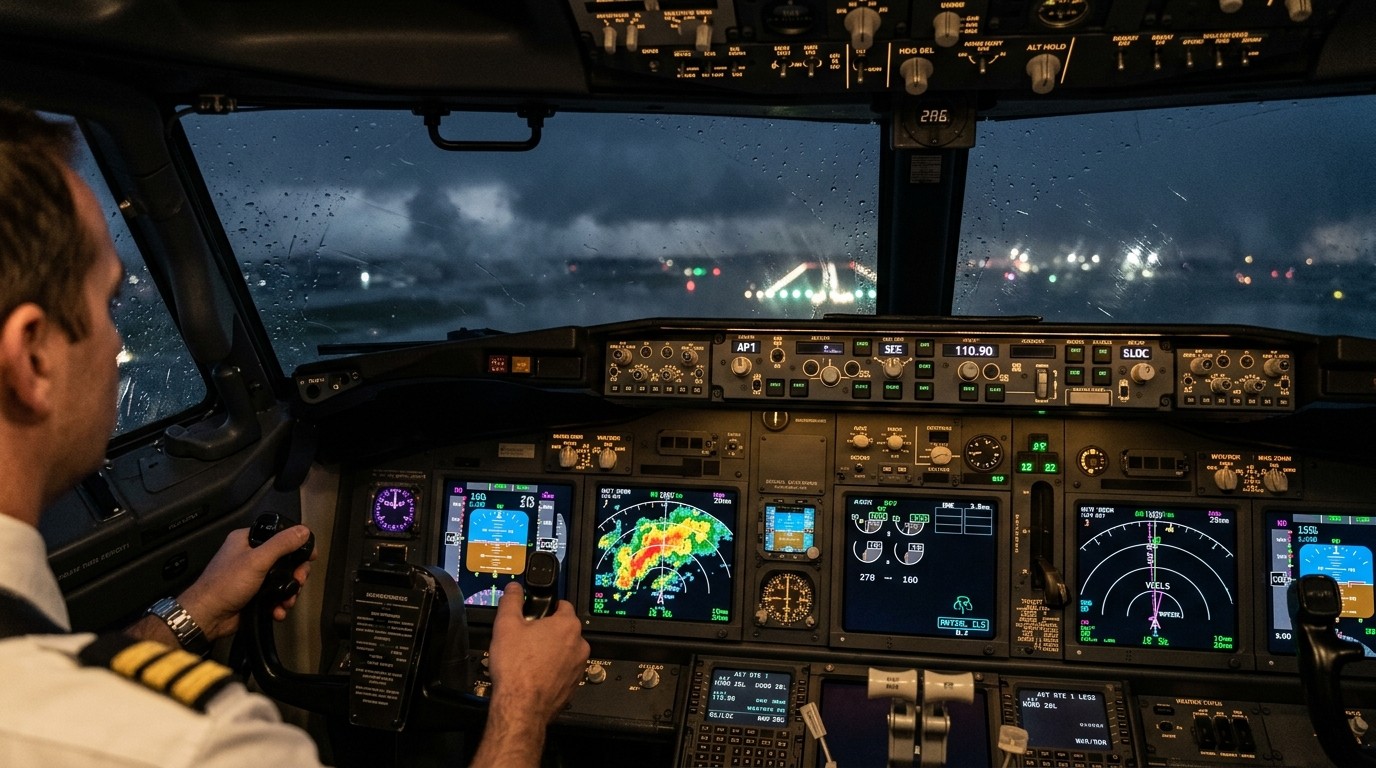
Cockpit Instrumentation becomes even more important when outside visual references weaken. Clouds, haze, night operations, and precipitation all reduce the usefulness of the horizon and ground cues. In such conditions, Cockpit Instrumentation becomes the pilot’s trusted reference. The instruments do not remove risk, but they help manage it intelligently.
Cockpit Instrumentation is also tied to weather awareness. Good pilots do not wait until turbulence or low visibility becomes a surprise. They check forecasts, route conditions, and airport updates before departure. Reliable Aviation Weather Services help pilots understand convective activity, icing risk, ceilings, winds, and changing visibility. That information allows the instrument scan to be interpreted in context rather than isolation.
A pilot who knows the likely wind direction, cloud layers, and convective trends can better anticipate changes in pitch, power, and heading.
Modern Glass Cockpits Versus Traditional Gauges
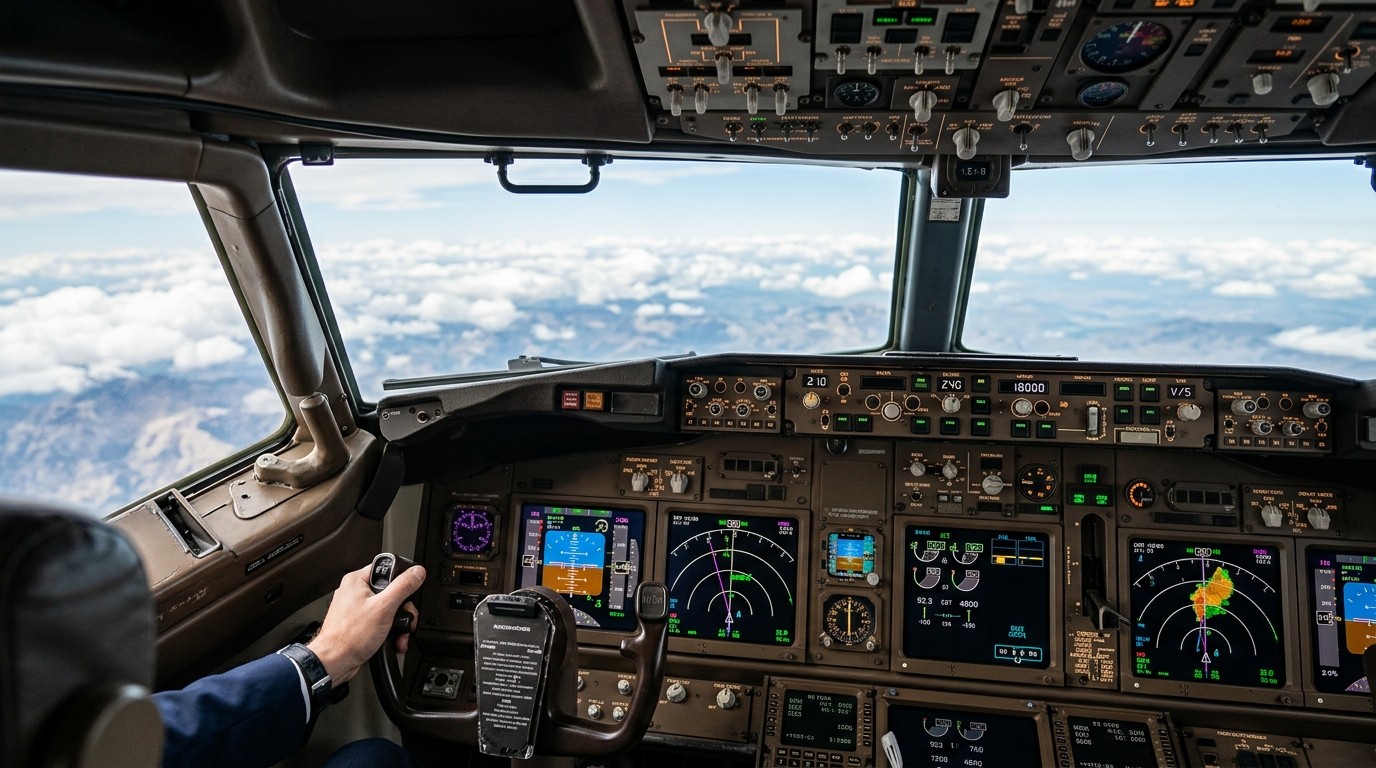
Cockpit Instrumentation looks different in modern aircraft, but the logic remains recognizable. Glass cockpits may present attitude, speed, altitude, and navigation in digital formats with color coding and trend vectors. That can improve readability, but it can also create dependence on screen design if the pilot does not understand the underlying principles.
Cockpit Instrumentation in a glass cockpit still requires the same discipline. The pilot must know what each readout means, how it behaves, and how to cross-check it. Technology can make flight easier, but it does not eliminate the need for basic understanding. In fact, the more advanced the panel, the more valuable the fundamentals become.
Cockpit Instrumentation also benefits from redundancy. If one display fails or a system behaves unexpectedly, the pilot who understands the basic six can keep flying with better composure. Technology changes quickly, but the core physics of flight do not.
Scan Patterns That Work
Cockpit Instrumentation becomes practical through scan habits. A common method is to start with attitude, then check speed, altitude, and heading, then confirm the turn and vertical trend. The exact order may change by aircraft and phase of flight, but the principle remains the same: keep the scan moving and complete.
Cockpit Instrumentation training often emphasizes small, regular eye movements rather than long stares. A good scan gives the brain repeated updates. That rhythm helps the pilot detect slow drift before it becomes a deviation.
Cockpit Instrumentation also benefits from phase-specific priorities. During takeoff, attitude and airspeed may dominate. During cruise, altitude and heading may matter more. During approach, vertical speed and speed control become critical. The pilot is always scanning, but not every instrument receives equal weight all the time.
Practical Interpretation Examples
Cockpit Instrumentation becomes easier to understand when real examples are used. If the attitude indicator shows a slight nose-up pitch and the airspeed begins to decrease, the pilot should recognize that lift margin may be shrinking. If the vertical speed indicator shows an unplanned descent, the pilot should check whether power or pitch has changed.
Cockpit Instrumentation can also reveal a crosswind correction issue. If the heading is correct but the track is drifting, the pilot may need to adjust for wind. If the turn coordinator shows an uncoordinated turn, the pilot may need to refine rudder input. These examples show that the instruments are not isolated pictures; they are clues in a larger flight story.
Cockpit Instrumentation rewards students who practice seeing patterns rather than memorizing numbers only. A number is useful, but a trend is often more valuable. When the pilot sees the trend early, the correction is easier, smoother, and safer.
Building Confidence Through Practice
Cockpit Instrumentation becomes natural through repetition. At first, learners may feel overwhelmed by the number of displays, but regular practice turns confusion into structure. The pilot starts recognizing what “normal” looks like for each phase of flight, and that pattern recognition dramatically improves confidence.
Cockpit Instrumentation training should include both ground study and flight practice. The ground study explains what each instrument measures and why it matters. The flight practice shows how fast each reading changes and how the aircraft feels when numbers move. Together, theory and experience create stronger retention.
Cockpit Instrumentation also benefits from scenario-based learning. Rather than only practicing level flight, students should practice climbs, descents, turns, holding patterns, and approach setups. Each scenario gives the basic six a different job, and that variety deepens understanding.
From Student to Proficient Pilot
Cockpit Instrumentation eventually becomes a habit rather than a task, and with practice it becomes an automatic rhythm. That transition is one of the clearest signs that learning is working. When the panel begins to “make sense” at a glance, the pilot can devote more attention to planning and decision making.
Cockpit Instrumentation is also where good discipline shows up. Pilots who maintain calm scans, verify pressure settings, and respect trends usually develop stronger control habits.
Cockpit Instrumentation, at its best, creates trust between pilot and machine. The pilot learns that the aircraft is not mysterious, only responsive. Once the pilot can interpret the basic six correctly, the cockpit becomes less intimidating and more intelligible.
Practical Tips for Better Understanding
Cockpit Instrumentation is easier to learn when each instrument is tied to one core question. Airspeed answers how fast through the air. Attitude answers how the aircraft is oriented. Altitude answers how high. Vertical speed answers whether the aircraft is climbing or descending. Heading answers where the nose points. Turn coordination answers whether the turn is balanced.
Cockpit Instrumentation also becomes more memorable when students verbalize what they see. Saying the scan out loud during training can reinforce the habit and reveal weak points.
Cockpit Instrumentation should never be studied as a static chart only. The panel is dynamic, and the pilot’s eye must be dynamic too. Practicing the scan in sequence, checking trends, and matching readings against expected performance creates lasting competence.
Cockpit Instrumentation is ultimately about situational awareness. The more clearly the pilot understands the panel, the less likely it is that a small deviation becomes a large problem.
Conclusion
Cockpit Instrumentation is the foundation of safe, informed flying because it turns invisible aerodynamic behavior into readable information. The basic six instruments are the pilot’s first and most reliable guide to attitude, speed, altitude, climb or descent, heading, and turn quality. Once a pilot learns how they work together, the cockpit becomes less intimidating and more predictable. Good instrument habits support smoother flying and judgment in normal and challenging conditions. Whether an aircraft uses analog gauges or modern displays, the same principles apply: scan, cross-check, interpret, and decide. Mastering the basics creates the discipline that every safe flight depends on.
Frequently Asked Questions (FAQ)
1. What are the basic six in Cockpit Instrumentation?
The basic six in Cockpit Instrumentation are the airspeed indicator, attitude indicator, altimeter, vertical speed indicator, heading indicator, and turn coordinator or turn-and-slip indicator.
2. Why is Cockpit Instrumentation so important for new pilots?
Cockpit Instrumentation is important because it gives new pilots a reliable way to understand aircraft movement, maintain control, and avoid guesswork during every phase of flight.
3. Does Cockpit Instrumentation matter in glass cockpits too?
Yes. Even in digital displays, Cockpit Instrumentation still follows the same flight logic. The presentation changes, but the need for attitude, speed, altitude, and direction awareness remains.
4. How does Cockpit Instrumentation support Pilot Decision Making?
Cockpit Instrumentation supports Pilot Decision Making by giving the pilot clear data to compare with expected flight performance, which helps decide whether to continue, correct, or change plan.
5. How do Aviation Weather Services connect to Cockpit Instrumentation?
Aviation Weather Services provide information about winds, visibility, turbulence, ceilings, and storm activity, which helps pilots interpret Cockpit Instrumentation in the proper weather context.
6. What is the best way to learn the six instruments?
The best way is to study each instrument’s purpose, practice a consistent scan, and fly different phases of flight so the instruments become familiar in changing situations.
7. Can Top Travel Apps help pilots?
Top Travel Apps are more relevant for trip planning and passenger convenience than direct flying, but they can help with logistics such as ground transport, accommodation, and route organization.
8. Are Best Flight Tracking Apps useful for pilots and aviation fans?
Best Flight Tracking Apps are useful for monitoring routes, departures, arrivals, and aircraft progress, which can support situational awareness and interest in aviation operations.
9. What is the biggest beginner mistake with Cockpit Instrumentation?
The biggest beginner mistake is fixating on one instrument and ignoring the cross-check. Pilots need the full picture, not a single number in isolation.
10. How does practice improve Cockpit Instrumentation skills?
Practice builds pattern recognition, scan discipline, and confidence. Over time, the pilot learns what normal looks like and notices deviations much faster.