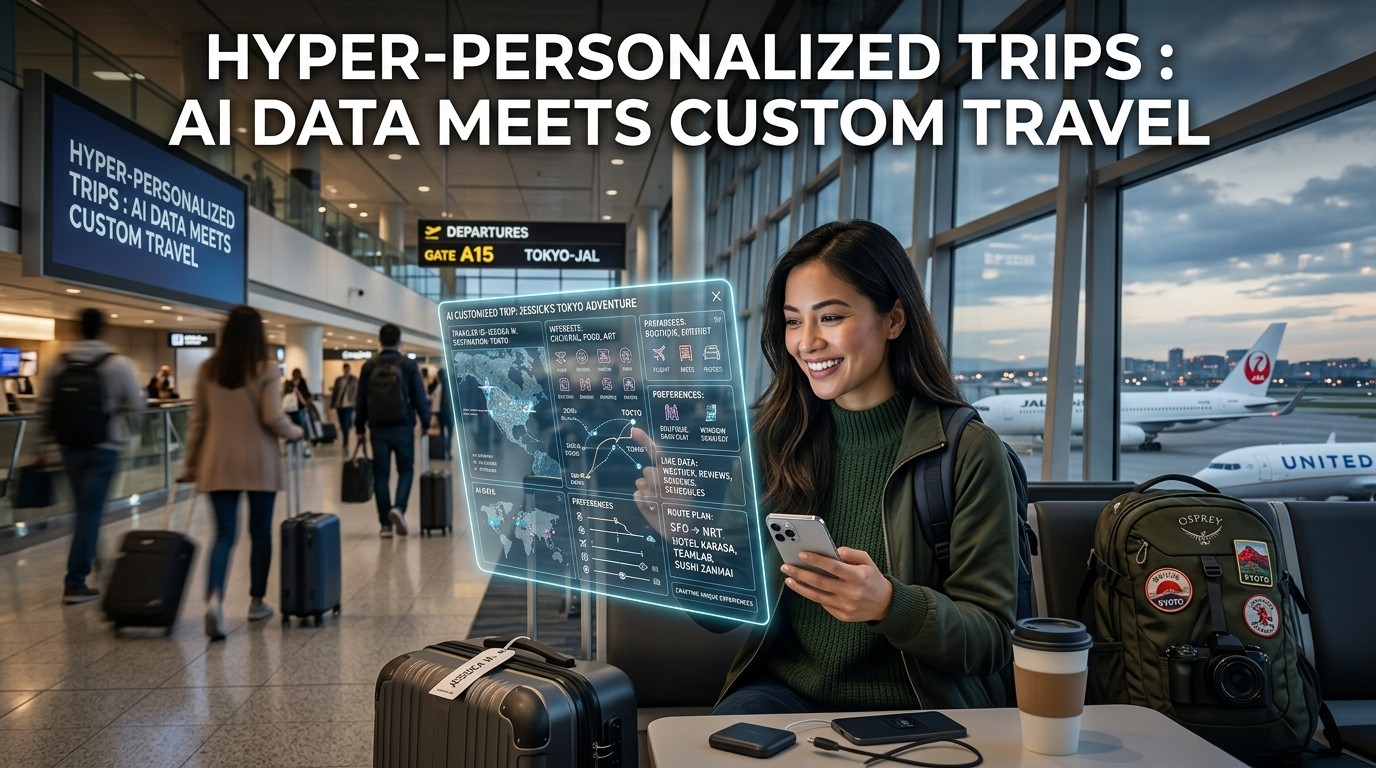
Hyper-Personalized Trips combine traveler data, AI intelligence, preferences, and real-world context to create more relevant, flexible, efficient, and meaningful travel experiences.
Travel planning used to begin with a destination, a hotel, a list of famous attractions, and a standard itinerary copied from a guidebook. Today, travelers increasingly expect something more relevant to their personality, budget, schedule, interests, comfort level, and purpose. This shift is creating a new model of travel planning centered on Hyper-Personalized Trips.
Instead of asking, “What should everyone do in this city?” modern travelers can ask, “What would make this destination perfect for me?” That difference sounds small, but it changes the entire planning process. Hyper-Personalized Trips are designed around the individual rather than the average tourist.
Artificial intelligence makes this possible at a much larger scale. Systems can analyze preferences, previous choices, travel behavior, trip duration, spending patterns, preferred activities, transportation preferences, and even the pace at which a traveler likes to move. The result can be a much more relevant itinerary than a generic ten-point travel guide.
However, personalization is not simply about adding more data. Hyper-Personalized Trips only become genuinely valuable when information is translated into useful decisions. A traveler does not want 200 recommendations. They want the right five.
This is where the future of travel becomes especially interesting. Hyper-Personalized Trips can combine behavioral data with live context, human preferences, local knowledge, and AI-generated recommendations to create experiences that feel more intentional.
But there is another side to the story. More personalization means more data. More automation can also mean more dependency on algorithms. Travelers must therefore understand not only how personalization works, but also its limitations, privacy risks, accuracy problems, and best practices.
The goal of this guide is to explain the entire concept clearly, from the data foundations behind Hyper-Personalized Trips to practical examples, AI workflows, privacy considerations, mistakes, and a framework for building better custom travel experiences.
What Are Hyper-Personalized Trips?
At the simplest level, Hyper-Personalized Trips are travel experiences built around an individual traveler rather than a broad audience.
A normal travel recommendation might say, “Visit the top attractions in Paris.”
A personalized recommendation might say, “Visit two museums in the morning, spend the afternoon in a quieter neighborhood, prioritize cafés over nightlife, avoid long walking routes, and reserve one evening for a scenic dinner because you prefer slower-paced experiences.”
That distinction is the foundation of Hyper-Personalized Trips.
The first model assumes that popularity equals relevance. The second model attempts to understand the person.
Hyper-Personalized Trips can use many categories of information. Some are explicitly provided by travelers, such as budget, destination preferences, dietary requirements, preferred hotel category, and desired trip length. Others can be inferred from behavior, such as whether a traveler repeatedly chooses cultural attractions over amusement parks or prefers independent restaurants over large chains.
The value of Hyper-Personalized Trips comes from combining these signals instead of treating them separately.
For example, a traveler may say that they like hiking, but the best recommendation depends on additional factors. How difficult should the hike be? How much transportation are they willing to take? Do they prefer sunrise or afternoon hikes? Do they enjoy crowded national parks or isolated trails? Are they traveling alone?
Hyper-Personalized Trips attempt to answer those questions.
Another important characteristic is adaptability. The ideal itinerary is not permanently fixed. If rain appears in the forecast, a personalized system should be able to move outdoor activities and recommend indoor alternatives.
This is why Hyper-Personalized Trips are different from static itineraries. They are designed as responsive travel systems rather than simple schedules.
Ultimately, Hyper-Personalized Trips are about relevance. The goal is not to maximize the number of recommendations. The goal is to maximize the usefulness of each recommendation.
How AI Turns Travel Data Into Personal Recommendations
The engine behind Hyper-Personalized Trips is usually a combination of data, algorithms, natural-language processing, recommendation models, and contextual information.
AI does not need to know everything about a traveler to provide useful recommendations. Even a relatively small number of meaningful preferences can dramatically change the itinerary.
For example, consider two travelers visiting the same city for four days.
Traveler A wants architecture, independent cafés, museums, and photography opportunities. They enjoy walking, avoid nightlife, and prefer mid-range boutique hotels.
Traveler B wants shopping, nightlife, luxury restaurants, short transportation times, and premium hotels.
A generic itinerary would struggle to satisfy both. Hyper-Personalized Trips allow the system to create two completely different experiences from the same destination.
The process begins with data collection. Travelers may provide information through questionnaires, conversations, previous bookings, loyalty accounts, travel profiles, or interaction history.
The system then identifies patterns.
It may determine that a traveler frequently chooses experiences rated highly for quiet environments. Another traveler may repeatedly prefer adventure-based activities.
Hyper-Personalized Trips use these signals to rank options.
The ranking process is critical. A recommendation engine may have hundreds of possible activities, but it needs to determine which ones deserve priority.
AI can score choices based on factors such as:
| Data Signal | Example |
|---|---|
| Budget | $100 daily activity limit |
| Interests | Food, culture, hiking |
| Pace | Slow, moderate, fast |
| Accommodation | Boutique hotel |
| Transport | Walking and public transit |
| Time | Four-day trip |
| Group | Solo traveler |
| Preferences | Fewer crowds |
| Past behavior | Frequently chooses museums |
| Context | Rain expected on Day 2 |
The more relevant signals the system can combine, the more customized the result can become.
Yet Hyper-Personalized Trips should not be confused with perfect prediction. AI works from available information. If the traveler gives incomplete or inaccurate preferences, recommendations can also become inaccurate.
This creates an important principle: personalization quality depends on both data quality and reasoning quality.
A sophisticated system can process enormous amounts of information, but it still benefits from clear human input.
From Preferences to Travel Intent

One of the most important developments in Hyper-Personalized Trips is the ability to interpret intent rather than only explicit preferences.
Suppose a traveler says, “I want a relaxing trip.”
That sentence contains very little useful detail on its own.
Relaxing could mean a beach resort, a quiet mountain cabin, spa treatments, slow city walks, nature photography, or simply fewer scheduled activities.
AI systems can improve Hyper-Personalized Trips by asking or inferring additional questions.
Do you want relaxation through nature or luxury? Do you enjoy spontaneous exploration? Do you prefer staying in one hotel or moving between locations? Do crowds make a destination stressful? How much planning feels comfortable?
These questions uncover the deeper travel intent behind the initial request.
Intent is particularly important because travelers often describe goals emotionally rather than technically.
Someone might say:
“I want a trip that feels special.”
The system must translate that into practical variables.
Maybe the person values unique food experiences.
Maybe they want hidden neighborhoods instead of famous landmarks.
Maybe they want one memorable luxury experience rather than a luxury hotel throughout the trip.
Hyper-Personalized Trips become more powerful when AI can connect emotional objectives with practical recommendations.
Another useful concept is priority weighting.
A traveler may care about five things, but they do not necessarily care equally.
For example:
| Preference | Priority |
|---|---|
| Food experiences | 10/10 |
| Quiet environment | 9/10 |
| Luxury hotel | 5/10 |
| Nightlife | 2/10 |
| Shopping | 1/10 |
A system that understands these weights can avoid wasting time on irrelevant suggestions.
This makes Hyper-Personalized Trips much more efficient.
Instead of creating a huge itinerary, the system allocates attention according to what actually matters.
The psychological benefit is equally important. Travelers often experience anxiety when planning because too many choices create decision fatigue. Personalization reduces that burden by filtering possibilities.
The traveler still makes the final decision, but the number of decisions becomes manageable.
How AI Travel Agents Fit Into Personalized Travel
The rise of AI Travel Agents is accelerating the development of Hyper-Personalized Trips because travelers can now interact with planning systems conversationally rather than through rigid search forms.
Instead of entering dates, destination, and hotel category separately, a traveler can describe an entire travel dream in natural language.
For example:
“I have five days, I love architecture and local food, I dislike crowded tourist zones, I want a comfortable hotel, and I do not want to change hotels more than once.”
An AI system can transform that conversation into structured planning criteria.
From there, it can generate multiple itinerary concepts.
One could maximize culture.
Another could emphasize food.
A third could prioritize relaxation.
Hyper-Personalized Trips benefit from this conversational approach because travelers often discover their own preferences while explaining what they want.
AI can also help during the trip.
Suppose a traveler planned three outdoor activities, but heavy rain appears on the second day.
Instead of manually rebuilding everything, the system can identify indoor alternatives that still match the traveler’s interests.
This introduces real-time personalization.
However, users should not assume every AI-generated recommendation is accurate. AI systems may produce incorrect opening hours, unrealistic transportation times, outdated prices, or businesses that no longer exist.
Therefore, Hyper-Personalized Trips should use AI for speed and organization while critical facts are independently verified.
AI can be the planner.
It should not automatically become the final authority.
A strong workflow looks like this:
- Traveler explains goals.
- AI identifies preferences.
- AI creates multiple options.
- Traveler chooses priorities.
- AI builds a draft itinerary.
- Key facts are verified.
- The itinerary is adjusted.
- Real-time conditions trigger further changes.
This hybrid model combines machine efficiency with human judgment.
The result can be more flexible than traditional travel booking and more personal than generic recommendation pages.
Hyper-Personalization Across the Entire Journey
Hyper-Personalized Trips should not begin when a traveler opens an itinerary and end when the flight lands.
The strongest systems personalize the entire journey.
Before booking, personalization can influence destination selection.
During booking, it can rank flights, hotels, transportation options, and activities according to personal priorities.
Before departure, it can generate packing suggestions, reminders, document checklists, and destination preparation.
During travel, it can adapt plans based on weather, transportation disruptions, availability, fatigue, and changing interests.
After travel, it can learn from feedback.
That final step is extremely important.
Suppose a traveler says, “The museum was excellent, but the three-hour walking tour was too long.”
A good personalization system should not treat that feedback as a one-time comment. It can interpret it as a preference signal.
The traveler may enjoy cultural content but prefer shorter guided experiences.
That information can improve future Hyper-Personalized Trips.
This creates a continuous learning loop.
Before the Trip
Personalization can optimize:
- destination choice;
- travel dates;
- hotel selection;
- flight options;
- activity categories;
- estimated daily spending;
- transportation style.
During the Trip
Personalization can optimize:
- daily schedules;
- route changes;
- restaurant selection;
- weather-based alternatives;
- crowd avoidance;
- energy management;
- spontaneous opportunities.
- After the Trip
- Personalization can learn:
- what the traveler enjoyed;
- what they disliked;
- how much they actually spent;
- what pace felt comfortable;
- which recommendations they ignored;
- which experiences they rated highly.
This creates a feedback ecosystem.
Hyper-Personalized Trips become stronger when the system learns what the traveler actually does rather than only what the traveler claims they like.
That difference is powerful because behavior can reveal preferences more accurately than questionnaires.
Personalization by Travel Personality
Not every traveler wants the same type of customization.
Hyper-Personalized Trips become more meaningful when they account for travel personality.
Consider several common traveler profiles.
The Slow Explorer
This traveler enjoys walking through neighborhoods, sitting in cafés, visiting fewer attractions, and spending longer periods in each place.
Their ideal trip should include breathing room.
The Achievement Traveler
This person wants to see a lot. They enjoy packed schedules, famous landmarks, and checking major experiences off a list.
Their itinerary can be denser.
The Comfort Seeker
This traveler prioritizes reliable transportation, quality hotels, easy access, and reduced uncertainty.
Their system should minimize logistical friction.
The Adventure Seeker
This traveler values outdoor activities, unusual experiences, challenging routes, and exploration.
Their recommendations should emphasize novelty and controlled risk.
The Social Traveler
This traveler wants markets, group activities, social spaces, festivals, and opportunities to meet other people.
Their itinerary should not be optimized for solitude.
These differences demonstrate why generic personalization often fails.
Adding someone’s favorite food to an itinerary does not make the trip truly personal.
Hyper-Personalized Trips should reflect how someone experiences travel, not just what attractions they click.
One traveler may see a packed schedule as exciting.
Another may see the same schedule as exhausting.
One traveler might consider a 30-minute train journey negligible.
Another might strongly prefer staying within one neighborhood.
AI can model these differences when the system gathers enough meaningful feedback.
This is where personalization becomes psychologically relevant. Travelers do not only buy destinations. They buy feelings: comfort, discovery, freedom, excitement, status, relaxation, connection, or accomplishment.
The best Hyper-Personalized Trips are designed around those emotional objectives.
Hyper-Personalized Trips for Different Budgets
Personalization is not exclusively a luxury feature.
A common misconception is that customization requires expensive hotels, private guides, and premium experiences.
In reality, Hyper-Personalized Trips can work at nearly any budget.
A budget traveler may prioritize free attractions, affordable local transportation, low-cost restaurants, flexible timing, and hostels or simple accommodations.
A mid-range traveler may prioritize balanced comfort, occasional premium experiences, and efficient transportation.
A luxury traveler may prioritize privacy, premium rooms, concierge support, private transfers, and high-end dining.
The intelligence comes from allocating the available budget toward what the traveler values most.
For example, a traveler with a $1,500 total budget may value food enormously but care little about hotel design.
The system could recommend:
- a simpler hotel;
- excellent local restaurants;
- one premium food experience;
- public transportation;
- fewer paid attractions.
Another traveler with the same budget may care deeply about accommodation and barely care about food.
The itinerary should therefore allocate money differently.
A useful budgeting model is:
| Traveler Priority | Budget Strategy |
|---|---|
| Food | Reduce hotel cost, increase dining budget |
| Comfort | Increase accommodation allocation |
| Adventure | Allocate more to activities |
| Photography | Invest in access and scenic locations |
| Relaxation | Reduce itinerary density |
| Shopping | Reserve flexible spending |
| Cultural depth | Allocate more to museums and guides |
This is one of the biggest advantages of personalization.
Instead of optimizing for average traveler spending, the system optimizes for personal satisfaction.
Hyper-Personalized Trips therefore turn budgeting into a value-allocation problem rather than simply a cost-cutting exercise.
Saving money is not always the objective.
Maximizing meaningful value is often more important.
Using Live Data Without Losing Human Judgment
Real-time context can make Hyper-Personalized Trips significantly more useful.
Travel conditions change constantly.
Weather changes.
Flights are delayed.
Restaurants become unavailable.
Events sell out.
Transportation systems experience disruptions.
A static itinerary cannot adapt intelligently to all these situations.
A personalized system can potentially identify changes and recommend alternatives that still fit the traveler’s preferences.
Imagine a traveler who planned a hiking day but wakes up to severe rain.
A generic system might simply suggest “indoor attractions.”
A personalized system might recognize that the traveler strongly values photography and food, then recommend a covered market followed by a highly rated food experience in the same area.
The difference is context.
The system is not simply replacing an activity. It is preserving the purpose behind that activity.
This is one of the most important principles behind Hyper-Personalized Trips.
Recommendations should preserve intent whenever conditions change.
Another example involves energy.
Suppose a traveler has already walked 18,000 steps by late afternoon.
Instead of continuing the original plan, a smart system could recommend a nearby restaurant, reduce the next activity, and move a distant attraction to another day.
This is personalized pacing.
However, live data should not become an excuse for constant itinerary changes.
Too much optimization can create instability.
Travelers also need confidence in the plan.
Hyper-Personalized Trips should therefore balance responsiveness with predictability.
The best systems make important adjustments while avoiding unnecessary changes.
The Privacy Problem Behind Personalized Travel
The more personalized travel becomes, the more data it may require.
That creates one of the most important questions surrounding Hyper-Personalized Trips: how much personal information should travelers share?
Potentially useful data could include:
- preferred destinations;
- travel history;
- spending behavior;
- accommodation preferences;
- dietary preferences;
- activity preferences;
- location;
- booking information;
- travel companions;
- calendar information;
- behavioral patterns.
Some of this data can be sensitive.
Travel platforms therefore need responsible data practices.
Travelers should understand what information is collected, why it is collected, how it is stored, whether it is shared with third parties, and how long it is retained.
The principle should be data minimization.
A system should not collect information simply because it can.
Hyper-Personalized Trips should use information that creates meaningful value for the traveler.
For example, knowing that someone prefers quiet cafés may be useful.
Knowing unrelated personal information may not be necessary at all.
Transparency also matters.
Travelers should know when AI is making recommendations based on historical behavior.
They should be able to modify important preferences and correct inaccurate assumptions.
A personalization profile should not become a permanent cage.
People change.
Travel preferences evolve.
Someone who prefers luxury travel this year may choose budget adventures next year.
Hyper-Personalized Trips should therefore remain editable.
Control is as important as convenience.
The best personalization system is not the one that knows everything.
It is the one that gives travelers meaningful control over what is known and how that information is used.
Common Mistakes in Building Personalized Itineraries
Even sophisticated systems can create poor travel plans.
One common mistake is over-personalization.
A system may try so hard to use every available preference that the itinerary becomes complicated.
A traveler may like museums, cafés, photography, history, markets, hiking, local food, architecture, and nightlife.
Trying to satisfy every preference every day creates overload.
The better strategy is selective personalization.
Choose the strongest priorities for each day.
Another mistake is confusing recommendation quantity with recommendation quality.
Hundreds of personalized options do not necessarily help.
They can increase decision fatigue.
Hyper-Personalized Trips should reduce choices where possible.
A third mistake is excessive optimization.
If the system attempts to find the mathematically shortest route between every activity, the trip may become efficient but emotionally unpleasant.
Travel is not a warehouse delivery problem.
Sometimes the longer scenic route is the better choice.
Another issue is algorithmic bias.
AI systems may repeatedly recommend the same popular locations because they have more available data and stronger online signals.
This can make supposedly personalized itineraries surprisingly generic.
To prevent that, recommendation systems should diversify options while still respecting personal preferences.
Finally, travelers should avoid assuming that AI knows them perfectly.
Preferences expressed in one trip may not apply to another.
Hyper-Personalized Trips work best when travelers can review and change assumptions.
The best system is collaborative.
AI suggests.
The traveler reacts.
AI learns.
The traveler remains in control.
Hyper-Personalized Trips and the Rise of Micro-Experiences

Modern travelers increasingly value individual moments rather than destination checklists.
A short sunrise walk.
A neighborhood bakery.
A local art workshop.
A quiet viewpoint.
A half-day cooking class.
A spontaneous conversation.
These moments can become the emotional core of a trip.
This is where smaller experiences become important.
A traveler may not need ten attractions per day. They may want two meaningful experiences surrounded by enough time to enjoy them.
Hyper-Personalized Trips can identify these micro-experiences based on interests and pacing.
Imagine a traveler who loves photography.
Instead of recommending the same top attractions as everyone else, the system could build a route around morning light, architectural details, quieter streets, and viewpoints that fit the traveler’s preferred walking distance.
Another traveler may love food.
Their trip could be structured around local markets, neighborhood restaurants, short cooking experiences, and regional specialties.
The destination remains the same.
The emotional experience becomes different.
That is the essence of personalization.
A short nearby adventure can also become meaningful. A Microadventure does not require a massive itinerary or international flight. It can be designed around one compelling experience close to home.
This approach makes personalized travel more accessible.
Travel becomes less about geographic distance and more about relevance.
Hyper-Personalized Trips can therefore create value even when the traveler has limited time.
A three-day trip can feel highly customized when every major activity supports the traveler’s actual priorities.
Digital Well-Being and Personalized Travel
Personalized planning can improve travel, but constant digital optimization can also create a new problem.
Travelers may become obsessed with checking recommendations, price changes, ratings, messages, weather updates, social media content, and itinerary changes.
The experience can become more screen-based than destination-based.
That is why Digital Detox Travel is becoming an interesting counterbalance to highly connected travel planning.
The concept is not about rejecting technology completely.
It is about deciding when technology is helpful and when it is distracting.
A personalized itinerary can intentionally create “offline windows.”
For example:
- morning without social media;
- phone use only for navigation;
- offline map during neighborhood exploration;
- technology-free dinner;
- scheduled notification breaks.
This may sound contradictory, but better personalization can actually support less digital consumption.
The system can prepare information in advance so the traveler does not constantly need to search.
Hyper-Personalized Trips should therefore include moments where the technology disappears into the background.
The best AI system may sometimes be the one that reduces the number of decisions you need to make.
A traveler should not need to ask an app every ten minutes what to do next.
There should still be room for curiosity.
Unexpected discoveries matter.
Unplanned conversations matter.
Simply sitting somewhere beautiful matters.
The purpose of personalization is not to eliminate spontaneity.
It is to create enough structure that spontaneity becomes possible without creating unnecessary chaos.
This balance can make Hyper-Personalized Trips more human.
How Viral Travel Hacks Fit Into Personalized Planning
Online travel culture produces endless advice, but personalized planning requires filtering.
A popular trick can be useful for one traveler and irrelevant for another.
This makes Viral Travel Hacks best treated as research inputs rather than universal rules.
For example, one traveler may benefit from traveling with only a carry-on, while another may require specialized equipment.
One person may love early-morning sightseeing.
Another may perform poorly with early schedules.
One traveler may optimize for the lowest airfare.
Another may prioritize flexible tickets.
Personalization determines which advice is relevant.
This is where AI can help sort information.
A system can potentially take a collection of travel ideas and classify them by usefulness for a specific traveler.
The result is not simply more information.
It is filtered information.
Hyper-Personalized Trips become more useful when the system can answer, “Which of these ideas actually fit you?”
This approach also reduces information overload.
Travelers no longer need to test every hack they encounter.
They can ask:
Does this work for my destination?
Does it match my budget?
Does it fit my risk tolerance?
Does it save enough to justify the effort?
Will it improve the experience?
If the answer is no, ignore it.
Good personalization is partly about knowing what not to recommend.
That can be more valuable than discovering another trick.
The future of travel content may therefore move from “Here are 50 hacks” to “Here are the five ideas that match your specific journey.”
A Step-by-Step Framework for Creating Your Own Personalized Trip
You do not need an advanced AI platform to start building a personalized trip.
Begin by defining the purpose of the journey.
Do you want rest, exploration, food, nature, culture, adventure, romance, social interaction, or a combination?
Then define non-negotiables.
Maybe the hotel must be quiet.
Maybe public transportation is preferred.
Maybe the trip cannot exceed a certain budget.
Maybe long walking distances are undesirable.
Next, rank your preferences.
Do not simply list twenty interests.
Choose the five that matter most.
Then identify constraints.
Consider time, transportation, budget, weather, opening hours, reservations, and energy.
Once those fundamentals are clear, use AI to generate options.
Ask for multiple versions rather than one final answer.
Compare them.
Remove what feels unnecessary.
Verify important facts.
Then create flexible blocks instead of packing every minute.
A practical personalized structure might look like:
| Day | Core Experience | Flexible Elements |
|---|---|---|
| Day 1 | Neighborhood discovery | Café, market |
| Day 2 | Major cultural attraction | Nearby food options |
| Day 3 | Nature experience | Weather backup |
| Day 4 | Food-focused day | Shopping or free time |
| Day 5 | Personal favorite | Departure preparation |
This structure keeps the itinerary organized without becoming rigid.
The system should know what is essential and what can move.
That distinction is central to Hyper-Personalized Trips.
An itinerary should have priorities, not just timestamps.
How Businesses Can Use Hyper-Personalized Trips
Personalization is also changing the travel industry.
Hotels can recommend services according to guest preferences.
Airlines can potentially personalize offers.
Tour companies can create activity packages based on traveler interests.
Destination marketing organizations can segment audiences more intelligently.
Restaurants can recommend experiences based on dining behavior.
Travel platforms can create dynamic recommendation feeds.
The commercial benefit is obvious.
When recommendations become more relevant, travelers are more likely to engage.
But personalization can also become intrusive.
A business should not assume that every traveler wants aggressive upselling.
For example, a traveler who repeatedly ignores spa promotions may not want to see the same offer every day.
A useful system learns not only what customers like, but also what they dislike or ignore.
This requires thoughtful data use.
Businesses should focus on service relevance rather than endless promotion.
The strongest Hyper-Personalized Trips may actually feel less commercial because recommendations appear naturally within the journey.
Imagine a hotel noticing that a guest enjoys local food and then providing three genuinely relevant nearby options instead of pushing ten unrelated offers.
That feels helpful.
The difference is trust.
Personalization should create the feeling that the system understands the traveler without making the traveler feel watched.
That distinction will become increasingly important as AI becomes more deeply integrated into travel platforms.
Measuring Whether Personalization Actually Worked
A personalized trip should not be judged by how technologically impressive the system looks.
It should be judged by the traveler’s experience.
Useful measurements can include:
| Metric | What It Shows |
|---|---|
| Recommendation acceptance | Whether suggestions were relevant |
| Activity satisfaction | Quality of individual experiences |
| Itinerary changes | Whether plans were realistic |
| Budget accuracy | Whether spending matched expectations |
| Travel stress | Whether personalization reduced friction |
| Time efficiency | Whether logistics improved |
| Repeat usage | Whether the traveler found the system valuable |
| Feedback quality | What should improve next time |
Traveler satisfaction is more important than recommendation volume.
Suppose a system recommends twenty activities and the traveler enjoys only two.
That is not highly successful personalization.
Another system might recommend six activities, and the traveler loves five.
The second system is better.
This is why Hyper-Personalized Trips should be measured through relevance rather than complexity.
A technically sophisticated system can still fail if it does not understand the traveler.
Feedback loops are therefore essential.
After each trip, travelers can rate experiences.
What was excellent?
What was unnecessary?
What was too expensive?
What felt too rushed?
What would you repeat?
What would you avoid?
The answers can gradually improve future recommendations.
Over time, the system becomes less generic.
But the human traveler still defines success.
Technology can measure patterns.
Only the traveler can decide what the trip meant.
Future Possibilities for AI-Powered Personalized Travel
The next stage of Hyper-Personalized Trips could involve even deeper contextual awareness.
Future systems may combine preferences, calendars, weather, transportation, location, historical behavior, loyalty benefits, and real-time availability into one planning environment.
A traveler might say:
“I have four free days next month. I want nature, good food, minimal airport hassle, and moderate spending.”
The system could propose several destinations rather than requiring the traveler to search one by one.
Another possibility is continuous trip adaptation.
Instead of generating the complete itinerary once, the system might continuously adjust recommendations according to actual behavior.
If you repeatedly skip museums, the system may reduce them.
If you spend more time in local markets, future suggestions may prioritize similar environments.
This creates dynamic personalization.
But future systems will also face difficult questions around privacy, transparency, algorithmic bias, business incentives, and user control.
A system might recommend a hotel because it is genuinely suitable.
Or it might recommend it because the platform earns more commission.
Travelers will need transparency.
The most trusted Hyper-Personalized Trips will likely come from systems that clearly distinguish between personal relevance and commercial promotion.
The future is therefore not simply more AI.
It is better AI with better boundaries.
Travelers should gain convenience without losing autonomy.
The Human Element AI Cannot Replace
The most important thing to remember is that technology cannot fully understand the emotional meaning of travel.
A traveler might visit a city because of a childhood memory.
A family trip might be connected to a personal milestone.
A solo journey may represent freedom after a difficult period.
A destination may matter because someone dreamed about visiting it for years.
Algorithms can recognize patterns.
They cannot completely replace personal meaning.
That is why the most successful Hyper-Personalized Trips combine machine intelligence with human interpretation.
AI can handle data.
AI can compare options.
AI can organize logistics.
AI can surface possibilities.
But the traveler chooses what matters.
This human layer is essential.
A perfectly optimized itinerary can still be emotionally empty.
An imperfect itinerary can become unforgettable because of one unexpected moment.
Personalization should therefore serve human experience rather than dominate it.
The traveler should never become a passenger inside their own algorithm.
The system should be a tool.
The human should remain the decision-maker.
When that balance is maintained, personalization becomes genuinely powerful.
The Biggest Advantages of Hyper-Personalized Trips
When implemented thoughtfully, Hyper-Personalized Trips can improve travel in several important ways.
Better Relevance
Travelers receive recommendations that better match their actual preferences.
Lower Decision Fatigue
Instead of reviewing hundreds of options, travelers can focus on a smaller group of highly relevant choices.
More Efficient Planning
AI can organize large amounts of travel information faster than manual research alone.
Better Budget Allocation
Money can be directed toward experiences the traveler values most.
Greater Flexibility
Plans can adapt to weather, transportation, energy levels, and availability.
Stronger Discovery
Personalized systems can identify experiences that match niche interests.
Better Continuity
Past feedback can improve future trips.
These benefits make Hyper-Personalized Trips particularly attractive for travelers who find traditional itinerary planning overwhelming.
But personalization should not become complexity.
The system should make travel easier, not turn the traveler into a project manager.
The best result is a trip that feels simple even though sophisticated technology may be operating behind the scenes.
The Risks Travelers Should Watch Carefully
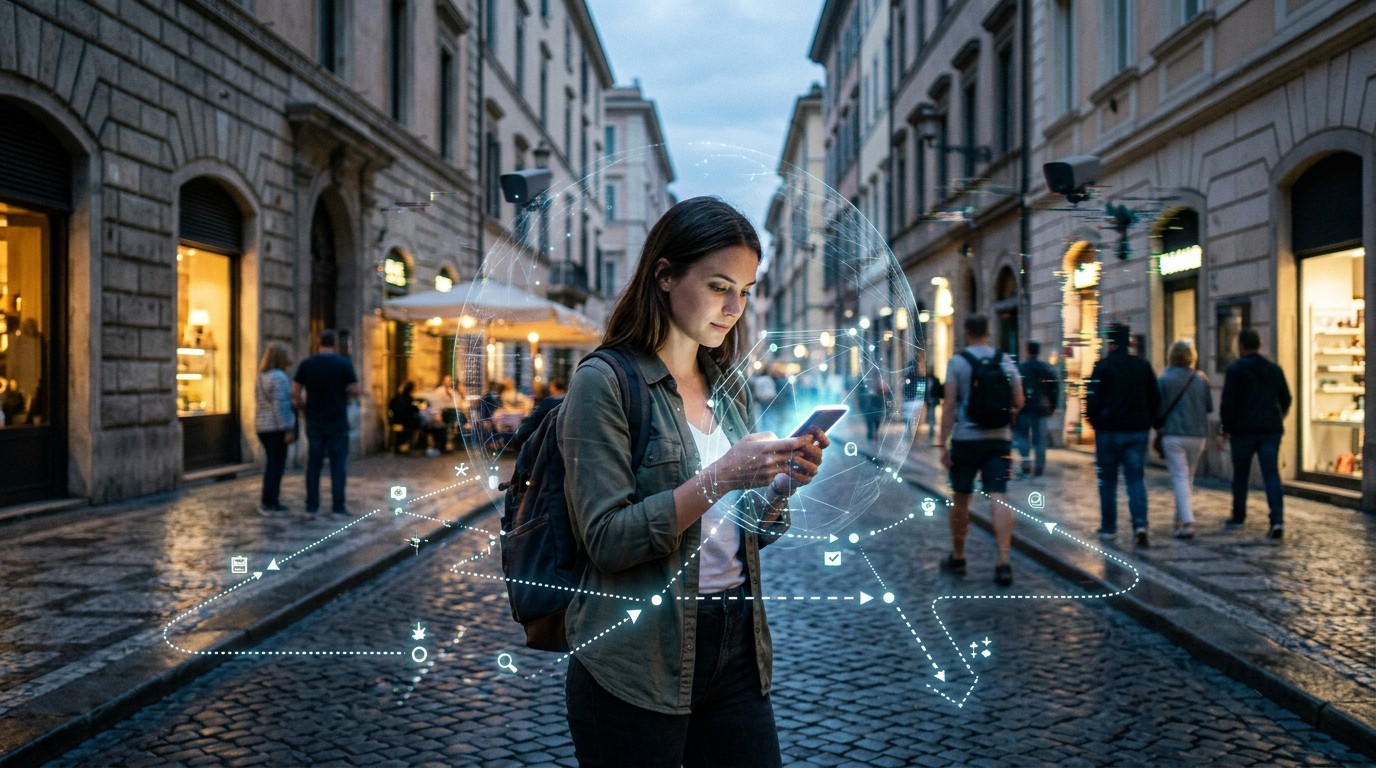
Every powerful technology has trade-offs.
Hyper-Personalized Trips can create risks when personalization becomes excessive.
One risk is the filter bubble.
If an algorithm learns that you love one type of restaurant, it may stop showing you alternatives.
You could miss experiences outside your established preferences.
Another risk is confirmation bias.
AI may repeatedly recommend what it predicts you will like instead of exposing you to something genuinely new.
A third risk is privacy.
The more detailed the profile, the more valuable the data becomes.
A fourth risk is over-automation.
Travelers may stop researching independently and accept recommendations without verification.
A fifth risk is commercial influence.
Platforms may prioritize experiences that generate higher revenue.
To build trustworthy Hyper-Personalized Trips, these risks need active management.
Travelers should be able to change preferences, request alternatives, and ask why a recommendation was made.
They should also have the ability to explore beyond the algorithm.
Personalization should narrow complexity without narrowing curiosity.
This is perhaps the most important balance in the entire concept.
The traveler should feel understood, not controlled.
The system should simplify the journey while preserving freedom.
Conclusion
Hyper-Personalized Trips represent a major shift from generic travel planning toward intelligent, individualized experiences built around real preferences, behavior, context, and intent. AI can analyze complex data, identify patterns, adapt itineraries, reduce decision fatigue, and make recommendations more relevant. Yet personalization works best when travelers remain in control. Privacy, accuracy, transparency, verification, and flexibility are just as important as automation. The strongest systems will not simply recommend more places; they will understand which experiences matter most to each person and when to leave room for spontaneity. Ultimately, Hyper-Personalized Trips are valuable because they make technology serve human travel goals rather than replacing the human experience itself.
Frequently Asked Questions (FAQ)
1. What are Hyper-Personalized Trips?
Hyper-Personalized Trips are travel experiences customized around an individual traveler’s preferences, behavior, budget, schedule, interests, travel style, and contextual needs rather than relying on generic itineraries.
2. How does AI create Hyper-Personalized Trips?
AI can analyze information such as traveler preferences, previous behavior, budget, trip duration, activity interests, accommodation choices, and contextual data to rank and recommend travel options that better fit the individual.
3. Are Hyper-Personalized Trips only for luxury travelers?
No. Personalization can work across budget levels. A budget traveler can receive recommendations optimized for affordable transportation, low-cost accommodations, free attractions, and local experiences just as a luxury traveler can receive premium recommendations.
4. Can AI Travel Agents replace human travel planners?
AI Travel Agents can automate research, comparison, itinerary drafting, and recommendation tasks, but they should not automatically replace human judgment. Critical information should still be verified, and travelers should remain responsible for major decisions.
5. What data is commonly used for personalized travel planning?
Potential information can include travel preferences, destination interests, accommodation choices, transportation preferences, budget, previous booking behavior, activity preferences, and feedback from previous trips. The exact data depends on the platform.
6. Are personalized travel recommendations always accurate?
No. AI systems can make mistakes, use outdated information, misunderstand preferences, or create unrealistic itineraries. Travelers should verify important details such as opening hours, transport schedules, prices, booking rules, and entry requirements.
7. How can I create Hyper-Personalized Trips without advanced technology?
Start by defining your trip purpose, ranking your top priorities, identifying constraints, choosing a realistic budget, and selecting only activities that match your travel style. AI can then help organize and refine those choices.
8. What is the role of Viral Travel Hacks in personalized planning?
Viral Travel Hacks can provide ideas for saving time, reducing costs, or improving convenience, but they should be filtered according to your destination, budget, travel style, and current rules instead of being treated as universal advice.
9. Can personalized travel become too personalized?
Yes. Excessive personalization can reduce variety, create filter bubbles, increase privacy concerns, and discourage travelers from exploring unfamiliar experiences. Good personalization should provide relevance while still allowing discovery and choice.
10. What is the future of Hyper-Personalized Trips?
The future is likely to involve more adaptive AI systems that combine traveler preferences with real-time context such as weather, schedules, availability, transportation, and previous feedback. The most successful systems will balance convenience, personalization, privacy, transparency, and human control.