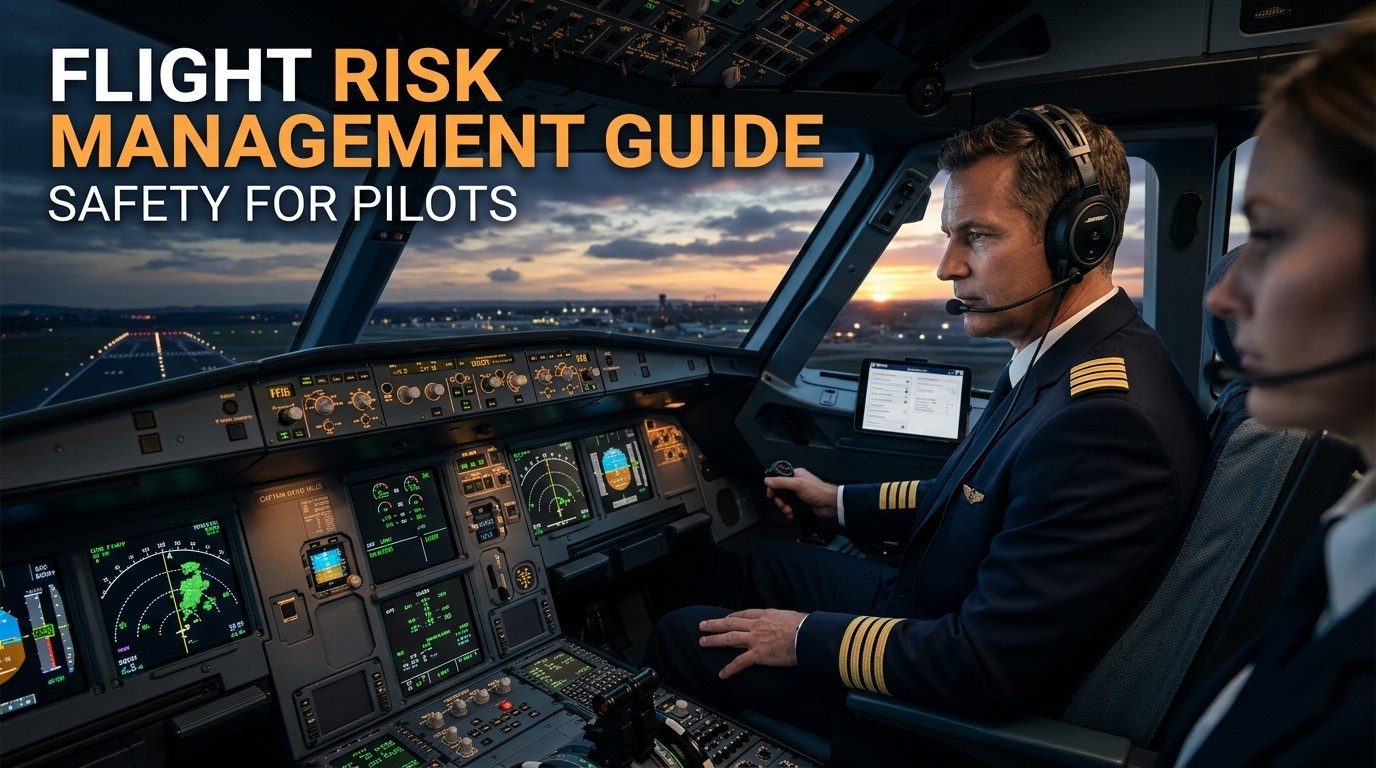
This guide explains how pilots identify hazards, assess risk, and make safer decisions before, during, and after flight. It is built for practical use, human judgment, and safer operational habits.
A Flight Risk Management Guide is one of the most useful safety tools a pilot can use because aviation is never completely free from uncertainty. Weather changes, aircraft limitations, human fatigue, operational pressure, and unexpected technical issues can all affect the outcome of a flight. The purpose of a risk management system is not to remove every danger, but to make sure every risk is recognized early, judged correctly, and handled with discipline.
That is especially important for pilots because flying is a decision-making job as much as it is a technical skill. A pilot may know how to operate an aircraft perfectly and still make a poor choice if stress, weather, schedule pressure, or overconfidence gets in the way. A strong Flight Risk Management Guide gives structure to those decisions so the pilot can stay calm, logical, and consistent even when conditions become less than ideal.
What Risk Management Means
A Flight Risk Management Guide is a structured way of spotting hazards, measuring their seriousness, and deciding what to do about them before they become a threat to safety. It helps a pilot ask better questions. Instead of only asking whether a flight is possible, the pilot also asks whether it is wise, whether the conditions are changing, and whether the current plan is still the best option.
The most important part of this idea is that risk is not the same as danger in the abstract. A risk becomes serious when multiple factors start to stack up. A little fatigue, a little bad weather, a little pressure to arrive on time, and a little uncertainty about aircraft performance can combine into a much larger safety issue. A Flight Risk Management Guide gives the pilot a practical way to see that pattern early enough to act.
Why Pilots Need It
Pilots need a Flight Risk Management Guide because aviation is full of situations where small mistakes can have large consequences. That does not mean flying is unsafe by nature. It means good judgment matters, and a consistent process makes good judgment more reliable. The human brain tends to underestimate slow-building risks, especially when a flight has been planned for a long time or when someone is eager to complete the mission.
A risk management system also helps pilots deal with emotion. Many poor aviation decisions come from pressure rather than lack of knowledge. A pilot may continue into bad weather because the destination is close, or push on despite fatigue because the trip already feels committed. A Flight Risk Management Guide interrupts that thinking. It creates a habit of stopping, checking, and reassessing before the situation becomes more difficult.
Main Risk Categories

A practical Flight Risk Management Guide usually breaks flight risk into several major areas. The first is the pilot. This includes fatigue, health, experience, recency, stress, distraction, and confidence level. A pilot who is not mentally sharp can make weak decisions even if the aircraft is working normally.
The second area is the aircraft. Maintenance status, fuel, weight and balance, equipment readiness, and known defects all matter. A mechanically sound aircraft is not automatically a safe flight if performance margins are too tight or if the pilot does not fully understand the system status.
The third area is the environment. Weather, visibility, terrain, runway length, airport complexity, and airspace all shape the level of risk. A route that seems simple in good visibility can become difficult when conditions degrade.
The fourth area is external pressure. This includes schedule pressure, passenger expectations, business deadlines, and self-imposed urgency. Many pilots underestimate this category even though it often drives the final decision. A Flight Risk Management Guide works best when all four areas are reviewed together instead of in isolation.
Preflight Decision Making
A strong Flight Risk Management Guide begins before the flight even starts. Preflight is the best time to identify hazards because the pilot still has options. The plan can be delayed, the route can be changed, the fuel load can be increased, or the entire flight can be canceled before any pressure builds in the cockpit.
A useful preflight routine starts with an honest self-check. Is the pilot rested, healthy, alert, and current enough for the intended flight? Then comes the aircraft review. Is the airplane fully ready, correctly fueled, and within safe operating limits? After that comes the environment. Is the weather acceptable not just at departure, but also en route and at the destination? Finally, the pilot should check for pressure. Is there any reason to feel rushed, obligated, or emotionally attached to a bad decision?
If more than one area looks weak, the safest action is often to simplify the flight or stop altogether. That is the kind of judgment a Flight Risk Management Guide is meant to encourage. It is far better to delay a flight on the ground than to fight a bad situation in the air.
In-Flight Risk Control
Risk management does not end after takeoff. A Flight Risk Management Guide should help pilots continue to evaluate the flight while it is happening. Conditions may change. Weather can shift. Fuel burn may be different than expected. A runway may become unavailable. A pilot may become more tired or overloaded than expected.
Good in-flight control means staying aware of the actual situation, not the original plan. A pilot should continuously ask whether the flight is still within safe limits. If something starts to drift outside those limits, the right move may be to slow down mentally, reduce workload, and choose a safer alternative. That alternative might be altitude change, rerouting, earlier landing, diverting to another airport, or returning to the departure point.
The key habit is not waiting too long to act. A Flight Risk Management Guide works best when the pilot treats early action as a strength. Small corrections made early are usually much easier than major corrections made late.
Human Factors in Aviation
Aviation risk is not just technical. It is deeply human. That is why any serious Flight Risk Management Guide must include human factors. Fatigue can reduce awareness. Stress can narrow attention. Overconfidence can make a pilot ignore warning signs. Distraction can cause missed details. Pressure can push a pilot to continue when the safer choice is to pause.
One of the most dangerous human tendencies is normalization of deviance. That happens when a pilot gets used to flying in conditions that are slightly outside ideal limits and starts treating that as normal. Another risk is confirmation bias, where the pilot looks for evidence that supports the original plan and ignores evidence that suggests a problem. A good Flight Risk Management Guide helps break those patterns by forcing the pilot to look at the situation fresh each time.
This is also where psychology matters most. The pilot must be able to say “not today” without feeling weak or embarrassed. In reality, that decision often shows more professionalism than pushing forward for pride, convenience, or habit.
A Simple Risk Workflow
A Flight Risk Management Guide becomes much easier to use when it follows a repeatable workflow. One effective approach is to identify the hazard, judge the level of risk, choose a response, and then review the result after the flight. That way the pilot is not just making a decision once. The pilot is learning from every decision.
The process can be thought of in four steps.
- Recognize the hazard.
- Understand how serious it is.
- Decide whether to accept, reduce, delay, or remove it.
- Review what happened and learn from the outcome.
This pattern is useful because it works in both training and real operations. It turns safety into a habit rather than a one-time briefing item. A Flight Risk Management Guide should be simple enough that a pilot can actually use it when distracted, rushed, or tired.
Ways to Reduce Risk

A Flight Risk Management Guide should not only identify danger. It should also show pilots how to lower it. There are several practical ways to do that. One is to delay the flight until weather or conditions improve. Another is to choose a simpler route or airport. Another is to carry more fuel than the minimum required if operating rules allow it. A pilot can also reduce workload by flying during daylight, avoiding complex airspace when possible, or asking for assistance when needed.
Risk can also be reduced by setting personal minimums that are stricter than the legal minimums. Legal minimums are not the same as personal comfort or safety margins. A pilot may legally continue but still decide that the margin is too thin for the actual conditions. That distinction is important. A Flight Risk Management Guide should support conservative thinking rather than minimum-legal thinking.
Single-Pilot Operations
Single-pilot flying makes risk management even more important because there is no second crew member to share the burden. Every scan, every radio call, every checklist item, and every judgment call belongs to one person. That means workload can rise very fast if weather, traffic, navigation, or equipment issues all demand attention at the same time.
A Flight Risk Management Guide for single-pilot operations should therefore be conservative. Simpler routes, extra time, generous fuel planning, and strong weather limits all help keep the mission manageable. A single pilot should also avoid stacking too many demanding factors into one trip. For example, combining low sleep, an unfamiliar airport, and marginal weather is exactly the kind of situation that deserves a pause.
That mindset is similar to how some travelers compare Solo Travel Ireland or Iceland Solo Travel options before choosing a route. The difference is that aviation has much narrower safety margins, so the need for disciplined planning is even stronger.
Practical Pilot Habits
Good risk management is not only about formal checklists. It is also about everyday habits. A pilot who uses a Flight Risk Management Guide well tends to build routines that protect judgment long before the airplane is moving. Those routines might include checking weather earlier than necessary, briefing an alternate plan, reviewing fuel margins twice, and pausing before departure to ask whether any pressure is influencing the choice.
Another valuable habit is speaking the risk aloud. Saying a concern out loud often makes it clearer and harder to ignore. This can be especially useful when the pilot is tempted to minimize a problem. If something feels wrong, it usually deserves attention. The goal is not to create fear. The goal is to create clarity.
Pilots should also review each flight after landing. What changed? What felt easy? What became stressful? What warning signs were visible before the problem became obvious? That kind of reflection improves future decision-making and gives the Flight Risk Management Guide real long-term value.
Psychology of Better Decisions
A lot of flight safety comes down to psychology. A pilot may have the technical ability to make the trip, but the real question is whether the decision-making process is clear enough to handle uncertainty. A Flight Risk Management Guide helps with that because it slows the mind down and creates space for better thinking.
Human beings do not like abandoning a plan once they have invested time in it. This is why pilots sometimes continue when they should stop. They have already filed the route, briefed passengers, loaded baggage, and mentally committed to departure. The guide works as a psychological brake. It reminds the pilot that a good decision can still be made even after effort has already been spent.
That mindset connects naturally to Flight Safety and Travel Risk Management because both fields rely on the same principle: understand the risk before the risk starts controlling you. It also connects loosely to Adventure Travel Insurance, since insurance and risk analysis both exist to reduce the impact of uncertainty. In aviation, however, the objective is first to prevent the event, not simply recover from it.
Building a Better Safety Culture

A strong Flight Risk Management Guide also supports safety culture. When a pilot regularly uses a structured process, safety becomes normal rather than dramatic. It no longer feels like an emergency-only topic. Instead, it becomes part of everyday professional discipline.
That matters because pilots learn from their environment. If a workplace culture rewards rushing, hiding fatigue, or normalizing marginal decisions, risk rises. If the culture rewards honesty, conservative choices, and good judgment, safety improves. A Flight Risk Management Guide becomes most effective when it is supported by that kind of environment.
One of the best signs of a mature safety culture is when pilots feel comfortable delaying a flight for good reasons without embarrassment. That kind of environment protects everyone. It makes prudent decisions easier and risky behavior less attractive.
Conclusion
A Flight Risk Management Guide gives pilots a practical and repeatable way to make safer choices in a demanding environment. It helps them identify hazards, understand how risks combine, and decide when to continue, adjust, delay, or stop. The real value of the guide is not in making flying feel perfect. Its value is in making judgment more reliable.
When pilots use risk management well, they fly with more confidence and less stress because they know the plan has been tested against reality. That is what makes the guide so important. It protects not only the flight, but also the pilot’s ability to think clearly under pressure. In aviation, clear thinking is one of the strongest safety tools available, and a Flight Risk Management Guide is one of the best ways to build it.
Frequently Asked Questions (FAQ)
1. What is a Flight Risk Management Guide?
It is a structured approach pilots use to identify hazards, assess danger, and choose safer actions before and during a flight.
2. Why is it important for pilots?
Because it helps pilots avoid pressure-driven mistakes, recognize changing conditions, and make more consistent safety decisions.
3. What are the main risk categories?
Pilot condition, aircraft condition, environment, and external pressure are the main categories.
4. Is risk management only for commercial pilots?
No. It is useful for private pilots, student pilots, and single-pilot operations as well.
5. Can risk be fully removed from flying?
No. Aviation always involves some risk, so the goal is to manage it carefully and reduce it to an acceptable level.
6. What is the biggest human factor in aviation risk?
Fatigue, stress, overconfidence, and distraction are among the most common human factors.
7. How does a pilot reduce risk before departure?
By reviewing weather, aircraft readiness, personal condition, fuel, route complexity, and any external pressure.
8. What should a pilot do if risk rises during flight?
Reassess immediately and consider delaying, diverting, changing altitude, or returning if needed.
9. Why are personal minimums useful?
They give the pilot clear limits that are often more conservative than legal minimums, which improves safety margins.
10. How does risk management improve confidence?
It gives the pilot a repeatable decision process, so choices feel calmer, clearer, and less reactive.